
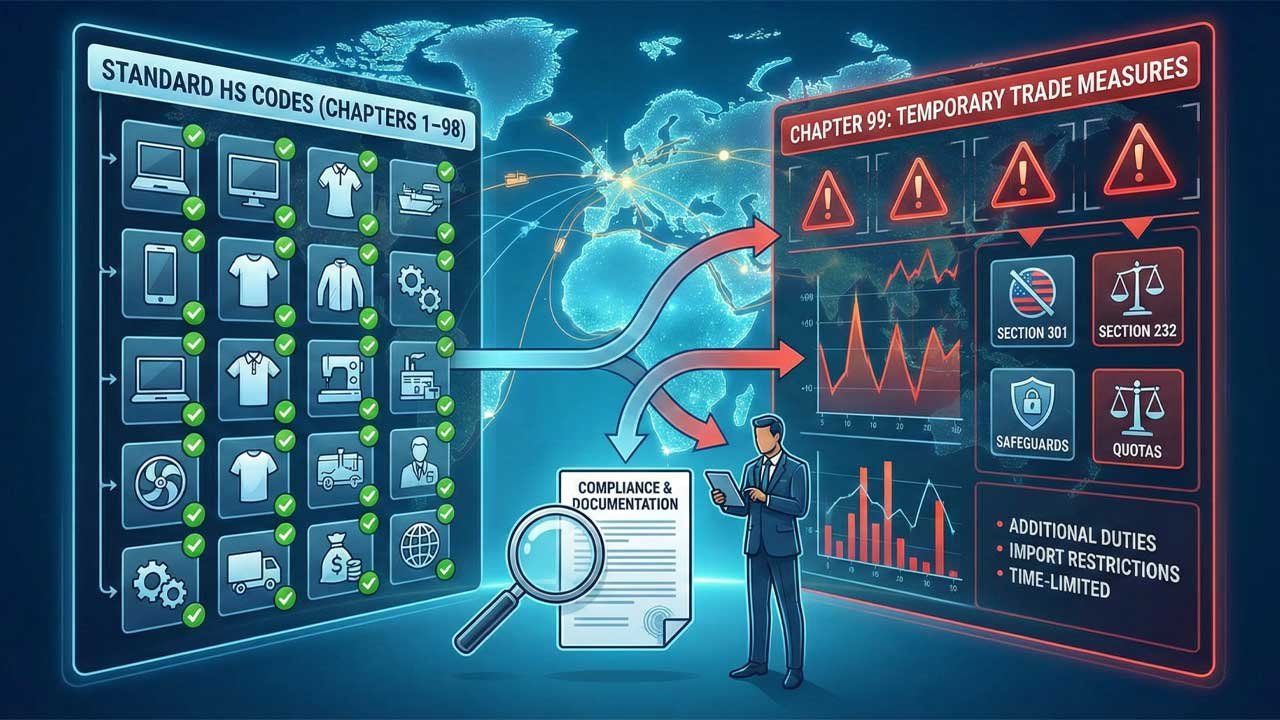
HS Code Chapter 99 is vital for international trade professionals. It handles temporary changes quickly. It manages new duties and restrictions fast. Importers and exporters must understand it well. Missing this knowledge costs money and delays shipments. This article explains everything clearly and simply.
What is HS Code 99?
HS Code 99 is special. It is not a regular product classification. Regular codes (Chapters 1-98) classify products globally. Chapter 99 handles temporary trade actions only.
The U.S. Harmonized Tariff Schedule uses Chapter 99 for temporary measures. These measures modify tariff rates. They add new duties and restrictions. They apply for specific time periods. They expire or update regularly.
This chapter works alongside Chapters 1-98. It does not replace them. It supplements and modifies them instead.
Why Does HS Code 99 Exist?
Governments change trade policies frequently. President Executive Orders create new tariffs overnight. Congress passes new trade laws regularly. Trade negotiations update continuously. Countries need a system for rapid updates. HS Code 99 fills this gap perfectly.
Without Chapter 99, updating 21,000+ tariff lines would take years. With it, changes apply immediately. This protects domestic industries. This enforces trade agreements. This maintains national priorities efficiently.
What Does Chapter 99 Include?
Additional Duties and Trade Remedies
Chapter 99 implements multiple duty types:
- Section 301 Tariffs (China retaliation)
- Section 232 Tariffs (steel and aluminum)
- Reciprocal Tariffs (recent trade policy)
- Safeguard Duties (injury relief)
- Anti-Dumping/Countervailing Duties (unfair trade)
Each has specific HS Code 99 subheadings. Each applies during announced time periods. Each requires proper documentation from importers.
Temporary Modifications to Tariff Rates
Chapter 99 adjusts existing tariff rates temporarily. A product normally taxed at 2.5% might face 10% temporarily. This happens under trade agreements. This happens during trade disputes. This happens for strategic reasons.
These modifications are time-bound. They typically last 6 to 12 months. Sometimes they extend multiple times. Businesses must track expiration dates carefully.
Import Restrictions and Quotas
Temporary restrictions appear in Chapter 99 regularly. Restrictions on sugar appear here. Agricultural quotas live here. Textile limits use these codes. These restrictions protect domestic producers temporarily.
Importers must monitor restrictions constantly. Missing a restriction causes seizure. It creates penalties and delays. It wastes money and time.
Understanding HS Code 99 Subheadings
HS Code 99 subheadings follow a pattern. They use 4-6 digit codes. Examples include:
| HS Code 99 Range | Purpose | Time Period |
|---|---|---|
| 9903.01.xx | General tariff modifications | Announced in advance |
| 9903.17.xx | Sugar quotas and limits | Annual cycles |
| 9903.18.xx | Specialty sugar rules | Seasonal periods |
| 9903.80.xx | Miscellaneous duties | Variable terms |
| 9903.81.xx | Specific country tariffs | Multi-year applications |
The specific numbers change annually. New codes replace old ones. The U.S. International Trade Commission publishes updates regularly.
Recent Examples of Chapter 99 Actions
India Tariffs (2025)
The U.S. imposed a 25% tariff on Indian products in August 2025. This action used specific Chapter 99 codes:
- HTS 9903.01.84: General 25% duty application
- HTS 9903.01.85: In-transit relief (goods shipped before August 27, 2025)
Importers had to reclassify goods using these new codes. Shipments loaded before August 27 qualified for relief until September 17.
China and Hong Kong Duties
China-origin goods faced doubled tariffs in 2025. The duty jumped from 10% to 20%. This used HTS 9903.01.24. In-transit goods used HTS 9903.01.23 for temporary exemption.
Canada and Mexico Changes
A 25% duty applied to Canadian goods (HTS 9903.01.10). Energy products faced only 10% duty (HTS 9903.01.13). These changes required immediate system updates.
How Chapter 99 Affects Your Import Export Compliance
Cost Implications
Chapter 99 changes directly impact landed costs. A shipment worth $100,000 might gain $25,000 in new duties. This affects profit margins significantly. Suppliers must adjust pricing immediately. Procurement teams must recalculate budgets.
Documentation Requirements
Customs requires precise tariff classification now. Goods must enter under the correct Chapter 99 subheading. Wrong classifications trigger:
- Shipment delays
- Penalty assessments
- Audit investigations
- Duty recalculations
Professional customs broker services ensure accuracy. Brokers charge fees ranging from $50 to $200+ per shipment. Their expertise prevents costly mistakes.
Timing and Entry Deadlines
Chapter 99 provisions have strict timelines. In-transit relief expires on specific dates. New duties begin at exact times. Missing deadlines costs thousands.
Example: Indian tariffs began August 27, 2025 at 12:01 a.m. EDT. Goods entered after this time faced 25% duty. Goods entered before faced original rates. One day made all the difference.
Free Trade Agreements Still Apply
Chapter 99 does not override Free Trade Agreements automatically. Goods from Mexico, Canada, or Korea may still qualify for preferential rates. Brokers must analyze both the base rate and Chapter 99 provisions. They must apply whichever is lower.
Trade Agreements Addressed in Chapter 99
Chapter 99 covers specific countries under trade agreements:
- Israel (U.S.-Israel FTA)
- Peru and Colombia (Peru-Colombia TPA)
- Morocco (U.S.-Morocco FTA)
- Australia (U.S.-Australia FTA)
- Costa Rica (CAFTA-DR)
- Panama (PANAMA TPA)
- Korea (U.S.-Korea FTA)
Each country may have unique Chapter 99 subheadings. These provide special rates during trade policy periods. Eligibility depends on rules of origin. Documentation must prove origin compliance.
Key Compliance Best Practices
1. Monitor Tariff Updates Constantly
Subscribe to U.S. Customs and Border Protection (CBP) alerts. Follow the International Trade Commission website. Check trade publications weekly. New Chapter 99 codes appear without warning.
Business impact: Companies catching changes early gain competitive advantage.
2. Get Tariff Classification Professionally Done
Don’t guess your HS codes. Wrong classifications trigger penalties. Professional customs tariff classification services cost $20-100 per product. They save thousands in penalties.
Software like Avalara or Digicust automates classification now. AI-assisted tools analyze product descriptions. They match the right codes within seconds.
3. Maintain Complete Records
Keep invoices, classifications, and duty payments for 5 years minimum. Customs audits look for documentation gaps. Missing records cost penalties. Digital record-keeping prevents problems.
4. Use Qualified Customs Brokers
Licensed customs brokers understand Chapter 99 deeply. They track deadlines. They file forms correctly. They prevent delays and penalties.
Brokerage service fees range from $50 to $200+ per shipment. This cost prevents much larger penalties. Many companies find it essential.
5. Calculate Import Duty Cost Accurately
Use duty calculators before importing. Know the landed cost beforehand. Budget for duties and taxes. Avoid surprise expenses.
Factors affecting duty cost:
- Product HS code (tariff rate)
- Declared commercial value
- Country of origin
- FTA eligibility status
- Applicable Chapter 99 provisions
Frequently Asked Questions
Q1: How often does Chapter 99 change?
A: Constantly. New provisions appear almost monthly. Changes can be temporary (6 months) or longer. Always verify current codes before importing.
Q2: Do import restrictions affect all products?
A: No. Most products are not restricted. But all products may face temporary duties under Chapter 99. Always check for your specific code.
Q3: Can I appeal a Chapter 99 duty?
A: Sometimes. If the product qualifies for FTA benefits, you may have options. The U.S. International Trade Commission handles binding rulings. Legal help may be necessary.
Q4: How do I get tariff consultation services?
A: Contact licensed customs brokers or trade consultants. Many offer free initial consultations. Expect to pay $100-500+ for detailed analysis. Investment prevents bigger problems later.
Q5: What if my shipment arrives during a code change?
A: Timing matters greatly. Goods loaded before a new duty starts may qualify for relief. In-transit relief provisions apply in some cases. Documentation timing is crucial. Brokers handle this complexity.
Q6: Does Chapter 99 affect export price quotations?
A: Not directly. But it affects import costs for your customers. If they import your goods, Chapter 99 affects their pricing. Understanding it helps you communicate better with buyers.
Conclusion
HS Code Chapter 99 is complex but essential. It changes trade costs overnight. It creates urgent compliance needs. It requires professional attention.
Smart importers monitor it daily. They hire customs compliance professionals immediately. They track all import export regulations updates. They budget for new duties. They protect their profit margins.
Missing Chapter 99 changes is expensive. Understanding them is profitable. Professional help is worth the cost. Stay informed, stay compliant, stay profitable.
Key Takeaways
| Aspect | Action Item |
|---|---|
| Monitoring | Subscribe to CBP alerts and ITC updates |
| Classification | Use AI tools or professional services |
| Documentation | Keep 5-year records digitally |
| Broker Services | Hire licensed professionals for shipments |
| Cost Management | Calculate duties before importing |
| Compliance | Verify Chapter 99 codes weekly |
Additional Resources
- U.S. Customs and Border Protection (CBP official updates and notices)
- U.S. International Trade Commission (HS code lookups and rulings)
- Federal Register (Proclamations and executive orders)
- CBP CROSS Database (Binding tariff information)


