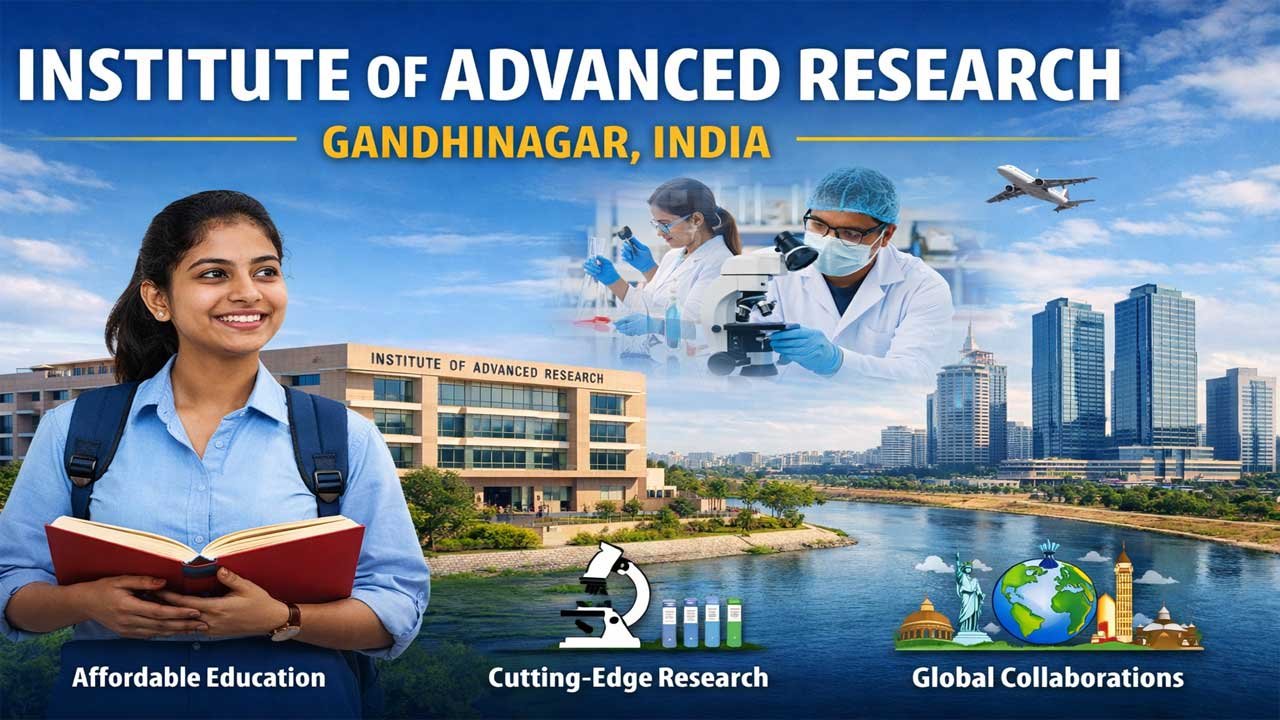
The Institute of Advanced Research (IAR), a UGC-recognized private research university in Gandhinagar, Gujarat, was founded with the endorsement of national leaders Narendra Modi and Dr. A.P.J. Abdul Kalam and has grown into a research-intensive institution offering over 40 undergraduate, postgraduate, and doctoral programs in engineering, science, management, and emerging interdisciplinary fields.
Backed by strong research funding, modern laboratories, 360+ publications, patents, and government grants, IAR emphasizes innovation, biotechnology, data science, and applied research, complemented by international collaborations with universities in the US, Europe, and Asia. Its strategic location near GIFT City enhances industry exposure, internships, and placements, while affordable tuition, English-medium instruction, and global degree recognition make it especially attractive to international students.
Though not positioned alongside India’s elite tier-1 institutions, IAR stands out for its value-for-money education, growing research reputation, and balanced focus on academics, industry engagement, and global exposure.
Institute of Advanced Research (IAR): India’s Premier Private Research University in Gandhinagar
Introduction: India’s Hidden Gem of Higher Education
The Institute of Advanced Research (IAR) stands as one of India’s most prestigious private research universities, located in Gandhinagar, Gujarat. With a remarkable founding story involving two of India’s most celebrated leaders—Prime Minister Narendra Modi (then Chief Minister of Gujarat) and former President Dr. A.P.J. Abdul Kalam—IAR has emerged as a beacon of innovation-driven education and cutting-edge research in South Asia.
For international students seeking world-class education at affordable tuition fees, strong placement outcomes, and research opportunities that rival premier institutions, IAR represents a compelling alternative to overcrowded government universities and expensive foreign options.
Part 1: A Legacy Built on Excellence and Strategic Leadership
Historical Foundation and Institutional Prestige
IAR’s founding narrative is deeply woven into India’s contemporary educational landscape. The foundation stone was ceremonially laid by Shri Narendra Modi in 2003 when he served as Chief Minister of Gujarat. The institution was formally inaugurated in April 2006 by Dr. A.P.J. Abdul Kalam, then serving as the President of India, marking a significant endorsement from the nation’s highest office. This dual recognition from both state and national leadership positioned IAR as a research-focused institution from its inception.
The university was granted university status in August 2011 under the Gujarat Private Universities Amendment Act, transforming from a research institute into a comprehensive academic institution. Importantly, IAR holds full recognition under Section 22 and Section 2(f) of the University Grants Commission (UGC), ensuring its degrees are recognized nationally and internationally. The institution is financially supported by the Puri Foundation for Education in India, established by Professor Nathu Ram Puri, a leading industrialist and entrepreneur based in the United Kingdom with global business interests.
This institutional architecture—combining research excellence with professional education, backed by international philanthropic support—sets IAR apart from many private universities in India that prioritize enrollment numbers over academic quality.
Strategic Location: Proximity to GIFT City and Economic Development
IAR’s location in Gandhinagar offers strategic advantages that directly benefit student learning experiences and career prospects. The campus is situated on the banks of the Sabarmati River in Gandhinagar, the capital city of Gujarat. More significantly, IAR is located just five minutes away from GIFT City (Gujarat International Finance Tec-City), which has been designated as India’s first smart city and is emerging as a major financial and technology hub.
This proximity to GIFT City translates into tangible benefits: students gain internship and recruitment opportunities with companies establishing operations in this rapidly developing financial technology ecosystem, exposure to emerging business models and technologies, and networking opportunities with industry leaders investing in India’s economic development. In recognition of this synergy, IAR signed a Memorandum of Understanding (MoU) with GIFT City in December 2024 to facilitate academic excellence and industry collaboration.
For international students, this location advantage cannot be overstated. Gandhinagar’s accessibility to Ahmedabad (approximately 35 kilometers), combined with its position as a rapidly urbanizing capital city, provides the infrastructure and lifestyle amenities necessary for global students while maintaining the academic focus of a university town.
Part 2: Academic Structure and Program Offerings
Comprehensive Portfolio of 40+ Courses
IAR offers an extensive portfolio of over 40 courses spanning undergraduate, postgraduate, and doctoral levels, providing pathways for students at every academic stage. This diversity allows students to progress through an integrated ecosystem—from Bachelor’s to Master’s to Ph.D. programs—within a single institution, fostering continuity in their academic and research journeys.
| Program Level | Specializations Offered | Duration | Typical Annual Fees |
|---|---|---|---|
| Bachelor of Technology (B.Tech) | Computer Engineering, Information Technology, Chemical Engineering, Biotechnology, Communications Engineering | 4 Years | INR 63,000-89,000 |
| Bachelor of Science (B.Sc) | Biotechnology, Microbiology, Biomedical Sciences, Digital Forensics & Cyber Security, Data Science & AI | 3-4 Years | INR 74,000-86,000 |
| Bachelor of Business Administration (BBA) | General Management | 3 Years | INR 61,600-79,000 |
| Bachelor of Computer Applications (BCA) | General IT Track | 3 Years | INR 68,000 |
| Master of Technology (M.Tech) | Computer Science Engineering, Information Technology | 2 Years | INR 63,000-69,457 |
| Master of Business Administration (MBA) | General Management | 2 Years | INR 75,000-1,09,000 |
| Master of Science (M.Sc) | Data Science, Biotechnology, Microbiology, Chemistry (Organic, Analytical, Industrial), Physics, Molecular Medicine, Computational Biology, Forensic Science, Nano Science & Technology | 2 Years | INR 60,000-92,000 |
| Master of Computer Applications (MCA) | General IT Track | 2 Years | INR 69,400 |
| Doctor of Philosophy (Ph.D) | 17 Specializations across Science, Engineering, Management | 2+ Years | INR 99,000-1,00,000 |
The presence of specialized M.Sc programs—particularly in emerging fields like Data Science, Computational Biology, and Molecular Medicine—indicates IAR’s commitment to contemporary, market-relevant education. These programs are designed not merely for academic credentials but for direct employment in high-growth sectors.
Flagship Programs: Engineering and Biotechnology Excellence
IAR’s B.Tech program functions as the institutional flagship, with the Computer Engineering specialization consistently attracting the most competitive applicants. For the 2025 admissions cycle, the JEE Main cutoff for B.Tech Computer Engineering stood at 17,445 (Round 1), while Biotechnology—reflecting IAR’s research strength in life sciences—had a cutoff of 6,832, indicating the university’s emphasis on biotechnology research and placing fewer seats in this specialization to maintain quality.
The biotechnology and biomedical science offerings deserve special attention for international students. IAR’s research in biotechnology has earned global recognition, with collaborations extending to the University of North Carolina School of Medicine for infectious diseases research and partnerships with Malaysian medical universities for clinical research. Students in these programs gain access to state-of-the-art research laboratories and opportunities to contribute to published research—a significant career advantage for those aspiring to doctoral studies or advanced research positions.
Part 3: Investment in Research and Innovation Infrastructure
Research Funding and Publication Record
IAR positions itself explicitly as a research-intensive university, a distinction that sets it apart from many private institutions in India that focus primarily on teaching. The scale of research at IAR is substantial: the university currently operates 15+ ongoing research grants with a sanctioned value exceeding INR 4.5 crores, supplemented by non-governmental funding approaching INR 35 lakhs annually.
This research infrastructure has generated measurable scholarly output: IAR maintains a portfolio of over 360 research publications in high-impact factor journals, with 15 patents published and 4 patents granted to date. These metrics, while modest compared to India’s premier institutions like IIT Delhi or IISc Bangalore, represent impressive achievement for a private university established only 20 years ago.
State-of-the-Art Laboratory Facilities
IAR’s commitment to research is reinforced by substantial investment in laboratory infrastructure. The university operates high-standard research laboratories equipped with 34 specialized instruments, including:
- AKTA Protein Purification System (protein characterization)
- Confocal Microscope (advanced cellular imaging)
- Real-time PCR and Gas Chromatography systems (molecular and analytical work)
- HPLC (High-Performance Liquid Chromatography)
- Ultracentrifuges and Sorval Centrifuges (sample separation)
- Biosafety Cabinets and Laminar Flow systems (compliant research environments)
- CO2 Incubators and Multiple Thermal Control systems
- Multi-Mode Microplate Readers and automated cell counters
These facilities comply with stringent safety guidelines monitored by Institutional committees including the Institutional Biosafety Committee (IBSC), Institutional Animal Ethics Committee (IAEC), and Institutional Chemical Safety Committee (ICSC). This regulatory compliance is crucial for students engaging in advanced biological or chemical research, as it ensures their work meets international standards—beneficial for those planning to pursue further studies or careers abroad.
Government Research Funding and Partnerships
IAR has attracted research funding from prestigious government agencies, demonstrating recognition of research quality at the national level. Funding sources include:
- Department of Biotechnology (DBT) – Programme Support grants
- SERB (Science and Engineering Research Board)
- DST (Department of Science and Technology)
- ICMR (Indian Council of Medical Research)
- GUJCOST (Gujarat Council on Science and Technology)
- GSBTM (Gujarat State Biotechnology Mission)
The university operates a seed grant program specifically designed to support early-career faculty, with INR 14 lakhs approved annually for research initiation by junior faculty members. This institutional commitment to nurturing emerging researchers creates opportunities for student collaborations across career stages.
Part 4: Placement Outcomes and Industry Engagement
2024 Placement Statistics and Industry Recognition
For students and parents evaluating educational ROI, placement statistics provide critical insight. During the 2024 placement cycle, IAR achieved notable outcomes despite global economic headwinds:
- Highest Package Offered: INR 18 LPA (approximately USD 21,500 annually)
- Average Package: INR 3.11 LPA (approximately USD 3,730 annually)
- Placement Rate by Department: Department of Business Management achieved 54% placements, Computer Science and Engineering 42%, Biotechnology and Bioengineering 19%
- Number of Recruiting Companies: Over 50 organizations visited campus for recruitment
The variation in placement rates across departments reflects realistic sector dynamics: management graduates are placed more frequently due to broader employer demand for business professionals, while biotechnology graduates pursue specialized research or doctoral pathways less frequently than immediate industry employment.
Top Recruiting Organizations and Sectors
The companies recruiting from IAR span pharmaceuticals, financial services, IT/ITeS, and FMCG sectors, providing career diversity:
Pharmaceutical & Life Sciences: INTAS Pharmaceuticals, Zydus, Torrent Pharma, Macleods, Meditab Software, Sun Pharma
Financial & Consulting Services: Axis Bank, HDFC, TATA Consultancy Services (TCS), EY, Capgemini
Manufacturing & Agribusiness: IFFCO, AMUL, Cygnet
Technology & Software: Meditab Software, EtechAx, Cygnet, various software consulting firms
This recruiter profile indicates that while IAR is not a preferred campus for top-tier technology companies (which primarily recruit from IITs and premier private institutions), it maintains strong relationships with mid-tier and specialized sector employers. For students seeking careers in pharmaceuticals, agribusiness, or mid-tier IT services, IAR placements offer genuine opportunities.
Industry-Academia Interface and Continuous Engagement
Beyond placement, IAR maintains ongoing industry engagement through structured mechanisms:
- Industrial Visits: Students undertake regular industry visits to witness real-world application of theoretical knowledge, enhancing practical context
- Memoranda of Understanding (MoUs): Companies enter into structured agreements with IAR for recurring recruitment and collaboration
- Consultancy Services: The university provides consultancy services to industry, creating research project opportunities for students
- Research Collaborations: Companies collaborate with IAR for specific research and development projects
- Guest Lectures and Workshops: Industry professionals engage with student cohorts regularly
These mechanisms transform universities from passive educational venues into active nodes in professional ecosystems, increasing intangible benefits of attendance.
Part 5: Rankings, Accreditation, and Institutional Recognition
National Rankings and Ratings
IAR’s institutional quality is validated through multiple national ranking frameworks. Most significantly, the university secured a 4-Star Rating in the Gujarat State Institutional Rating Framework (GSIRF) in 2024, assessed by the Knowledge Consortium of Gujarat and the Indian Centre for Academic Rankings & Excellence. Within this assessment, IAR ranked among the top 5 universities in Gujarat for research excellence, a distinction highlighting strength in scholarly output.
The university achieved 114th position in the IIRF (Indian Institutional Ranking Framework) 2024 overall rankings, placing it within the competitive tier of private universities in India. While not reaching the elite tier of India’s top 50 institutions (dominated by IITs and central universities), this ranking demonstrates institutional credibility within India’s private higher education sector.
UGC Recognition and Academic Legitimacy
Institutional credibility is anchored in formal recognition:
- UGC Approval: IAR operates under UGC recognition with explicit mention in Sections 22 and 2(f), enabling degree validity across India and globally
- Accreditation Status: The university maintains academic standards compliant with UGC CBCS (Choice Based Credit System) guidelines, ensuring curricular alignment with national standards
- Statutory Recognition: All degrees are recognized as equivalent to government university degrees for purposes of employment, further study, and professional registration
For international students, this formal accreditation is critical—many countries require institutional accreditation from India’s UGC for degree recognition.
Industry Awards and Recognition
Beyond formal rankings, IAR has received industry recognition:
- Emerging Gujarat Award: Presented by the Honorable Chief Minister of Gujarat, recognizing institutional contribution to state development
This award indicates recognition from state government leadership for the university’s role in advancing Gujarat’s knowledge economy.
Part 6: International Collaborations and Global Reach
Academic Partnerships Across Continents
IAR maintains academic and research linkages with leading universities across North America, Europe, and Asia, providing students with pathways for international engagement:
United States & North America:
- University of North Carolina School of Medicine (collaborative research in infectious diseases)
- University of Illinois at Chicago (biological sciences research)
- Institutions engaged through faculty research networks
Europe:
- University of Tuebingen, Germany (Applied Physics research collaboration)
- Nottingham Trent University, UK (student exchange and research opportunities)
- London South Bank University, UK (academic partnerships)
Asia:
- KAIST (Korea Advanced Institute of Science and Technology), South Korea
- Mahasa University, Malaysia (clinical research collaboration)
- Medical University, Malaysia (biomedical research initiatives)
These partnerships extend tangible benefits: students in postgraduate and doctoral programs gain opportunities for collaborative research internships, semester or year-long exchanges, and joint publication opportunities. Faculty collaborations ensure that IAR researchers remain connected to global scientific networks, elevating research quality through international standards.
Chamber of International Collaboration (IAR CIC)
To formalize and expand international engagement, IAR established the Chamber of International Collaboration (IAR CIC). This structure explicitly aims to facilitate partnerships with universities abroad and international organizations, signaling institutional commitment to internationalization—an increasingly important factor for universities competing in the global education market.
International Student Support and Admissions
IAR explicitly welcomes international students and maintains structured support systems:
- Online Application Process: International students apply through a prescribed online format with required documentation
- Visa Support: Institutional assistance with visa processing and documentation
- Accommodation Services: Support for securing student accommodation, including guidance on hostels and private housing options
- Cultural Integration: Diverse student body creates multicultural campus environment
Part 7: Admission Process, Eligibility, and Application Strategy
Eligibility Criteria by Program Level
Undergraduate Programs (B.Tech, B.Sc, BBA, BCA)
- Eligibility: Completion of 10+2 (or equivalent) from a recognized board
- Minimum Percentage: 50-60% in qualifying examination (program-dependent)
- Entrance Exams: JEE Main (B.Tech); GUJCET (B.Tech/B.Sc); Merit-based for B.Sc, BBA, BCA
- Selection Process: Merit-based counseling followed by personal interview (when required)
Postgraduate Programs (M.Tech, MBA, M.Sc, MCA)
- Eligibility: Bachelor’s degree or equivalent (relevant discipline for technical programs)
- Minimum Percentage: 45-60% in bachelor’s degree (program-dependent)
- Entrance Exams: CAT (MBA); GATE (M.Tech); Merit-based for M.Sc/MCA
- Selection Process: Counseling and personal interviews
Doctoral Program (Ph.D)
- Eligibility: Master’s degree with minimum 50% marks (or equivalent)
- Entrance Exam: UGC-NET (preferred) or institutional entrance test
- Selection Process: Entrance examination followed by comprehensive interview
Application Timeline and Process
The standard application process involves:
- Online Registration: Complete application form at iar.ac.in/admissions
- Documentation Submission: Provide educational certificates, identity proof, and required documents (for international students: passport, visa status documentation)
- Application Fee: INR 1,000 (non-refundable) for general applicants
- Entrance Examinations: Depending on program (JEE Main, GUJCET, CAT, GATE, etc.)
- Counseling/Interview: Invitation-based after merit determination
- Final Admission: Confirmation with fee payment
Admission Timeline for 2025-26 Academic Year: Typically, applications open in December/January for academic year beginning July/August. Students are advised to monitor the official website for specific deadlines.
Fee Structure and Cost Analysis
Understanding total cost of education is essential for international students planning financial budgets:
| Program | Annual Fees (INR) | Program Duration | Total Program Cost (INR) | Approximate USD Equivalent |
|---|---|---|---|---|
| B.Tech | 63,000-89,000 | 4 Years | 2,52,000-3,56,000 | USD 3,000-4,275 |
| B.Sc | 74,000-86,000 | 3-4 Years | 2,22,000-3,44,000 | USD 2,664-4,128 |
| M.Tech | 63,000-69,457 | 2 Years | 1,26,000-1,38,914 | USD 1,512-1,667 |
| MBA | 75,000-1,09,000 | 2 Years | 1,50,000-2,18,000 | USD 1,800-2,616 |
| M.Sc | 60,000-92,000 | 2 Years | 1,20,000-1,84,000 | USD 1,440-2,208 |
| Ph.D | 99,000-1,00,000 | 2+ Years | Variable | USD 1,188-1,200+ per year |
Key Financial Consideration: Compared to international universities, IAR fees are substantially lower. For context, a B.Tech degree at IAR (total cost: approximately INR 2.5-3.5 lakhs or USD 3,000-4,275) is significantly cheaper than comparable programs at universities in Southeast Asia (USD 15,000-25,000 for full program) or Western countries (USD 60,000-120,000+), making it an economically attractive option for cost-conscious international students.
Scholarships and Financial Aid
IAR offers merit-based and need-based scholarships to deserving students:
- Merit-Based Scholarships: Awarded to students with exceptional academic performance
- Financial Need Scholarships: Available for economically disadvantaged students
- State/Category-Based Scholarships: Applicable under specific government schemes
- Research Scholarships for Ph.D: Full-time research scholars receive financial support
International students are advised to contact the admissions office for specific scholarship eligibility criteria, as availability may be limited for non-Indian citizens.
Part 8: Campus Life, Facilities, and Student Experience
Academic Infrastructure
IAR provides comprehensive academic infrastructure supporting diverse learning styles:
Library Facilities:
- Expanded and renovated library with books across all subject areas
- AC and Wi-Fi connectivity throughout library spaces
- Digital access to academic journals and online databases
- Computer terminals for research and coursework
- Photocopying, printing, and scanning services
Classroom Infrastructure:
- Air-conditioned classrooms with modern teaching systems
- Wi-Fi connectivity across campus for digital learning resources
- Computer labs and specialized software access for technical programs
Technology Access:
- Dedicated computer center with broadband internet access
- Higher bandwidth connections available on payment basis
- Campus-wide Wi-Fi coverage
Residential Facilities
For students requiring on-campus housing, IAR provides targeted support, though dormitory capacity is limited relative to total enrollment:
- Separate Hostel Facilities: Boys and girls housed in separate facilities per Indian university norms
- Hostel Amenities: Hot water facilities, Wi-Fi access in hostels, messing services providing vegetarian meals
- Alternative Housing: Guidance for private hostels near adjacent PDEU campus
Important Note: As an emerging private university, IAR operates with limited on-campus residential capacity. Many students commute from nearby Ahmedabad or opt for private accommodations. International students should budget for private accommodation costs (approximately INR 5,000-15,000 per month, varying by location and amenities).
Sports and Recreational Facilities
Physical wellness and co-curricular engagement receive emphasis through comprehensive sports infrastructure:
Indoor & Outdoor Sports: Cricket, Football, Volleyball, Basketball, Badminton, Table Tennis, Athletics
Fitness Facilities: Modern gymnasium with contemporary equipment
Student Clubs and Organizations: Music Club, Photography Club, Literary Club, English Club, Dance Club, Sports Club, Fine Arts Club, Creativity Club, Entrepreneurship Club
These student organizations facilitate peer networking, leadership development, and extracurricular skills—factors increasingly valued by employers during campus recruitment.
Dining and Recreational Services
- Canteen Facilities: Extended canteen space providing meals throughout the day
- Messing Arrangements: Hostel messing with Indian vegetarian meal options
- Transport Services: Chargeable transport facility with pickup-drop arrangements from Ahmedabad (critical for non-residential students)
Part 9: Comparative Analysis: IAR Against Peer Institutions
For international students evaluating among multiple Indian universities, contextual comparison proves valuable. While direct institutional competitors vary based on academic program, useful reference points include regional peers and universities with similar research focus.
Comparative Metrics: IAR vs. Peer Private Universities (2024 Data)
| Metric | IAR | SAL College Engineering | LDRP Gandhinagar |
|---|---|---|---|
| Establishment Year | 2011 | 2012 | 2005 |
| IIRF Overall Ranking (2024) | 114 | Not Available | Not Available |
| B.Tech First Year Fees | INR 89,000 | INR 74,000 | INR 1,19,000 |
| Highest Package (2024) | INR 7 LPA | INR 3.60 LPA | INR 4.20 LPA |
| Average Package | INR 2.75 LPA | Not Specified | Not Specified |
Key Observations:
- IAR fees are positioned between lower-cost local colleges and premium private institutions
- Placement outcomes at IAR are competitive, with highest packages matching or exceeding nearby peers
- IAR’s research focus differentiates it from purely teaching-focused regional competitors
Positioning Relative to Premier Institutions
It is important to contextualize IAR realistically within India’s higher education landscape:
Tier-1 Institutions (IIT Delhi, IIT Bombay, IISc Bangalore): These premier institutes enjoy substantially stronger brand recognition, superior placement outcomes (average 16-22 LPA for technical graduates), and far greater research output. Admission to these institutions is significantly more competitive.
Tier-2 Research Universities (Manipal Academy, BITS Pilani, VIT): These institutions maintain comparable research profiles but typically operate with larger student populations and higher fees.
Tier-3 Regional Private Universities (Local engineering colleges, state private universities): IAR exceeds most regional private universities in research output, international recognition, and placement outcomes.
Strategic Positioning: IAR occupies a middle ground—offering research intensity and international exposure at significantly lower cost than Tier-1 premium private universities, while maintaining higher academic standards than many regional private colleges. This positioning makes IAR particularly attractive for international students seeking quality education at controlled costs.
Part 10: Why International Students Should Consider IAR
Compelling Value Propositions
1. Research Opportunities with Global Exposure
International students pursuing advanced degrees (M.Tech, M.Sc, Ph.D) gain access to:
- Faculty collaborations with leading global universities (University of North Carolina, KAIST, University of Tuebingen)
- Publication opportunities in peer-reviewed international journals
- Laboratory infrastructure meeting international standards
- Potential for research internships at partner universities abroad
For students aspiring to doctoral study or research careers, this institutional profile provides competitive positioning.
2. Economical Education Costs
The total cost of a B.Tech degree at IAR (approximately INR 2.5-3.5 lakhs or USD 3,000-4,275) represents exceptional value:
- Significantly lower than universities in developed economies (70-90% cost reduction)
- More affordable than comparable programs in Southeast Asia
- Includes access to state-of-the-art laboratory facilities
3. Strategic Location and Urban Ecosystem
Gandhinagar’s proximity to GIFT City and rapid urbanization provides:
- Internship opportunities in emerging financial technology sector
- Exposure to India’s economic development initiatives
- Network access to business leaders and entrepreneurs
- Quality of life amenities of a capital city
4. English-Medium Education
IAR’s complete delivery in English eliminates language barriers for international students, facilitating:
- Immediate academic engagement without language preparation
- Reduced culture shock compared to Hindi-medium institutions
- Network building with English-speaking peer cohorts
5. Credential Recognition
UGC recognition ensures degrees are:
- Accepted for further study in India and internationally
- Recognized by professional certification bodies
- Valid for visa sponsorship in countries like Canada, Australia, and the UK for advanced degree study
Conclusion: The IAR Advantage for Global Learners
The Institute of Advanced Research represents a nuanced opportunity in India’s higher education landscape. Founded with endorsements from two of India’s most celebrated leaders, supported by international philanthropic capital, and positioned within a rapidly developing economic zone, IAR combines institutional credibility with practical affordability.
For international students, IAR’s value proposition centers on research quality comparable to much more expensive alternatives, integration within India’s emerging knowledge economy, and cost economics enabling educational access. While not competing directly with India’s elite tier-1 institutions in brand recognition or placement outcomes, IAR excels in research intensity, international collaboration, and value-for-money positioning.
The 2026-2027 academic year presents an optimal entry point. The university’s recent GSIRF 4-Star Rating, MoU with GIFT City, and continued faculty recruitment suggest institutional growth trajectory. For students prioritizing research exposure, cultural immersion in a rapidly developing economic region, and educational costs at a fraction of global alternatives, IAR warrants serious consideration.
Visit iar.ac.in to explore program offerings, connect with the international admissions team, and request information on scholarship availability. Given application deadlines and processing timelines, early engagement (3-4 months before intended enrollment) is recommended.


