
This guide explains how to confidently handle ICAI exam stationery—especially the Main Answer Book, OMR cover sheet, MCQ OMR sheet, supplementary books, and the attendance register—so that administrative mistakes don’t cost marks.
It outlines exactly how to fill in the machine-readable cover page using a black ballpoint pen, avoid writing anything prohibited, correctly shade MCQ responses (usually with an HB pencil), manage supplementary sheets and tagging, and accurately paste barcode stickers and sign the attendance register. It also provides a timeline for when to complete each step during the exam and a final checklist of essential items to carry for a smooth, error-free experience.
Mastering Exam Logistics: A Deep Dive into ICAI Specimen Answer Books & Attendance Registers (Jan 2026)
While your conceptual knowledge decides what you write, your familiarity with ICAI’s official stationery decides how smoothly the process goes. A surprising number of students face anxiety not because of the questions, but because they are unsure how to fill out the OMR cover page or tag their supplementary sheets correctly.
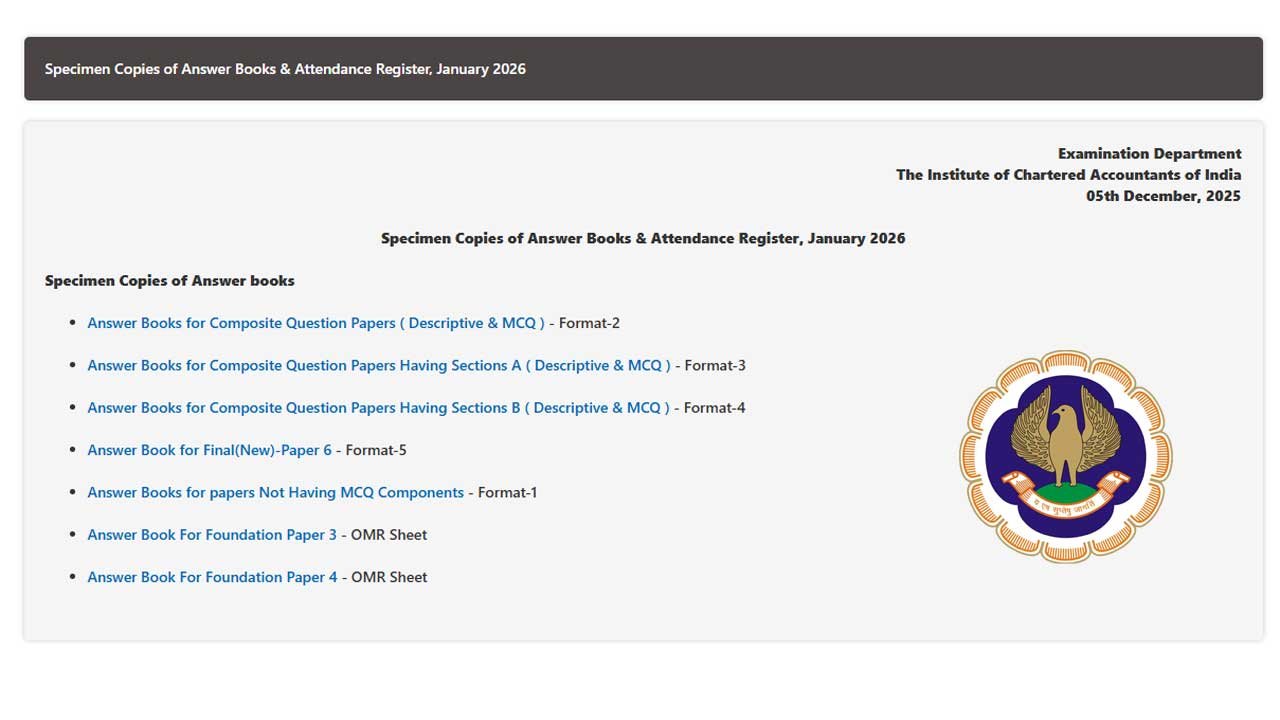
Specimen Copies of Answer Books & Attendance Register, January 2026
Answer Books for Composite Question Papers ( Descriptive & MCQ ) – Format-2
Answer Books for Composite Question Papers Having Sections A ( Descriptive & MCQ ) – Format-3
Answer Books for Composite Question Papers Having Sections B ( Descriptive & MCQ ) – Format-4
Answer Book for Final(New)-Paper 6 – Format-5
Answer Books for papers Not Having MCQ Components – Format-1
Answer Book For Foundation Paper 3 – OMR Sheet
Answer Book For Foundation Paper 4 – OMR Sheet
This guide deconstructs the Specimen Copies of Answer Books and Attendance Registers to ensure you navigate the exam hall like a pro.
The Main Answer Book: The Anatomy of Your Canvas
The ICAI Main Answer Book is a stitched booklet (usually 28 or 32 pages). The most complex part is the Cover Page, which is divided into specific sections that require careful attention.
The OMR Cover Sheet (Front Page)
The front page is machine-readable. It is divided into two parts by a perforation (which you must never tear).
- Part A (Top Half – Personal Details):
- Roll Number: Write your 6-digit Roll Number in the boxes and darken the corresponding circles beneath them. Critical: Use a Black Ball Point Pen only.
- Question Paper Code: Locate the code on your Question Paper (e.g., XYZ-123) and copy it here.
- Exam Level & Stream: Darken the circle for Foundation, Intermediate, or Final.
- Candidate’s Signature: Sign in the designated box. Match this signature with your Admit Card.
- Part B (Bottom Half – For Examiner Use):
- This section contains the grid for marks. DO NOT write anything here.
- Question Tick Box: There is a specific grid where you must tick (✓) the question numbers you have attempted.
- Strategy: Do not tick these at the start. Tick them in the last 5 minutes of the exam as you verify your answers.
“Instructions to Candidates” (Inside Cover)
The second page lists strict rules. Key takeaways often missed:
- The “Unfair Means” Trap: Writing “Om”, “Jai Mata Di”, your name, phone number, or request for passing marks anywhere inside the answer book or on the graph paper is treated as “Unfair Means.” This can lead to your result being withheld or a ban from future exams.
- Ruling and Margins: The pages usually come with pre-printed left-hand margins. Do not write in the left margin; it is reserved for the examiner to award marks. You may draw a pencil line for a right-hand margin to keep your work neat.
The OMR Answer Sheet (For MCQs)
For Foundation (all papers are descriptive or OMR-based depending on subject) and Intermediate/Final (papers with 30% MCQs), the handling of the OMR sheet is crucial.
The Sheet Layout
The sheet will contain circles numbered 1 to 100 (or less, depending on the paper).
Booklet Series Code: You must darken the circle corresponding to your Question Booklet Series (A, B, C, or D). If you miss this, the scanner won’t know which answer key to apply to your sheet.
Pencil vs. Pen Dilemma
Darkening Circles: While ICAI instructions have evolved, the standard requirement for OMR Sheets (MCQ) is often an HB Pencil.
However, for the Descriptive Answer Book Cover Page, a Black Ball Point Pen is mandatory.
Action: Carry both. Check the specific instruction printed on the OMR sheet regarding Pen vs. Pencil on the day of the exam.
Pro Tip: Never use gel pens or ink pens on OMR sheets. The ink can bleed through or smudge, causing the optical scanner to reject the sheet or read errors.
Supplementary Answer Books
Often, the main booklet isn’t enough.
- Requesting a Supplement: Ask the invigilator for a supplementary sheet at least 2 pages before you finish the main book. Don’t wait until the last line.
- The Header: The supplementary sheet also has a mini-cover page. You must fill in your Roll Number and Subject again.
- Tagging: ICAI usually provides a Tag (thread) rather than a stapler.
- How to Tag: Tie the supplementary sheet behind the main booklet. Ensure the knot is tight but allows the pages to turn freely.
- Hole Punching: The booklets usually come pre-punched. If not, ask the invigilator.
The Attendance Register: The Legal Record
The Attendance Register is more than just a sign-in sheet; it links your physical presence to your answer booklet.
The Barcode Sticker System
In many centers, you will be given a peel-off barcode sticker containing your Roll Number.
- Placement: You must peel this sticker and paste it on the specific box on the Cover Page of your Main Answer Book.
- Why? This barcode is how the system anonymously tracks your paper during evaluation. If you paste it crookedly or damage it, manual processing is required, delaying results.
Filling the Register
When the invigilator brings the register:
- Verify Name & Photo: Ensure the row belongs to you.
- Write Serial Number: Copy the distinct “Serial Number” printed on your Answer Book into the register. Double-check this digit by digit.
- Sign: Your signature here is the ultimate proof you took the exam.
Strategic Timeline for the Exam Hall
Here is how to interact with these documents chronologically:
| Time | Activity | Focus |
|---|---|---|
| 1:45 PM | Entry & Answer Book Distribution | Check the booklet for torn pages. Fill the OMR Cover Page (Roll No, Name, Exam). Do not open the inside pages yet. |
| 2:00 PM | Question Paper Distribution | Reading Time. Do not write answers. Read the questions. Verify the Question Paper Code and write it on the Answer Book Cover. |
| 2:15 PM | Writing Time Starts | Start writing inside the booklet. Ignore the “Questions Attempted” grid on the cover for now. |
| 5:00 PM | Warning Bell | Stop writing new answers. Tie your supplementary sheets. |
| 5:10 PM | Final Checks | Go to the Cover Page. Tick the “Questions Attempted” boxes. Ensure the OMR circles are fully darkened. |
Summary Checklist for January 2026
- [ ] Black Ball Point Pens: Carry at least 3. (One for you, one for backup, one for the student crying next to you).
- [ ] HB Pencils: For OMR shading.
- [ ] stapler/thread: (Optional) Carry a small stapler just in case, though threads are usually provided.
- [ ] No Whitener: Never use correction fluid on the OMR cover. If you make a mistake on the Roll Number, call the invigilator immediately. They have a specific protocol to rectify this (usually countersigning the error).


Leave a Reply
You must be logged in to post a comment.