
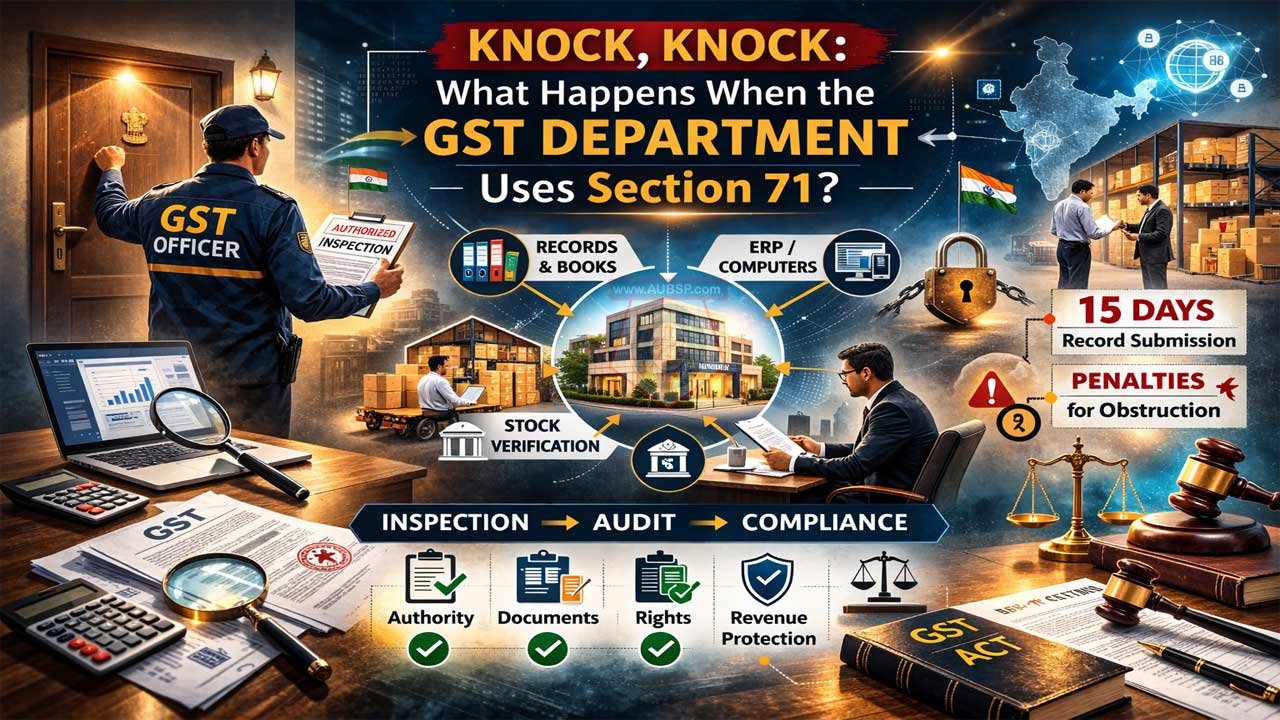
India’s GST system, introduced under the Central Goods and Services Tax Act, 2017, is based on self-assessment and trust, but it also gives tax officers powers to check compliance.
Section 71 allows authorized officers, with approval from a Joint Commissioner, to enter a registered business place to inspect books, records, and computer systems. This is different from a search under Section 67, which requires a stronger “reason to believe” and allows forceful action. Under Section 71, businesses must provide records within 15 working days and cooperate during inspections. If they refuse, they can face penalties.
The law also covers warehouses and places where books are kept. Courts have said officers must follow proper procedure and respect taxpayer rights. Overall, Section 71 balances government oversight with business responsibility and aims to protect revenue while ensuring fairness.
| Particulars | Details |
|---|---|
| Law | Central Goods and Services Tax Act, 2017 |
| Section | Section 71 – Access to Business Premises |
| Purpose | Inspection of records, verification, audit support |
| Who Authorizes | Officer not below rank of Joint Commissioner |
| Who Can Visit | Officer authorized by Proper Officer |
| Places Covered | Any place of business, warehouse, premises where books are kept |
| What Can Be Inspected | Books of account, documents, computers, ERP systems, software |
| Time to Produce Records | Within 15 working days (or extended period allowed) |
| Power to Use Force | No (force allowed only under Section 67 search) |
| Penalty for Obstruction | ₹10,000 or tax evaded (whichever higher) |
| Related Sections | Section 67 (Search), Section 66 (Special Audit), Section 122 (Penalties) |
Section 71 of the CGST Act Explained: GST Inspection, Access to Business Premises, and Taxpayer Rights
The implementation of the Goods and Services Tax (GST) in India transitioned the indirect tax landscape from a fragmented, opaque structure into a unified, technology-driven, self-assessment-based regime. Central to this paradigm shift is the concept of trust, as codified in Section 59 of the Central Goods and Services Tax (CGST) Act, 2017, which empowers the registered person to self-assess the tax payable and furnish a return for each tax period.
However, this trust is not absolute; it is balanced by a robust framework of administrative oversight. Chapter XIV of the CGST Act provides tax authorities with the tools necessary for inspection, search, seizure, and arrest—measures designed to safeguard government revenue and ensure that the playing field remains level for compliant businesses. Within this enforcement toolkit, Section 71, titled “Access to business premises,” acts as a critical bridge between routine desk audits and invasive search operations.
The Statutory Architecture of Section 71
Section 71 is designed to provide a legal basis for the physical interface between the tax administration and the taxpayer. Unlike a full-scale raid, which is governed by the high evidentiary threshold of Section 67, Section 71 provides a mechanism for authorized officers to enter business locations to verify records, conduct checks, and facilitate ongoing audits or investigations. The provision is split into two primary sub-sections that define the powers of the state and the obligations of the taxpayer.
Sub-section (1) establishes that any officer authorized by the proper officer—specifically one not below the rank of Joint Commissioner—shall have access to any place of business of a registered person. This access is granted for the purpose of inspecting books of account, documents, computers, computer programs, and software, whether installed in a computer or otherwise. The inclusion of digital infrastructure is a recognition of the modern reality where financial records are often stored in the cloud or within complex Enterprise Resource Planning (ERP) systems.
The term “access,” while not explicitly defined in the GST law, takes on a technical meaning often reconciled with Section 2(1)(9) of the Information Technology Act, 2000, which refers to gaining entry into or communicating with the logical, arithmetical, or memory function resources of a computer system.
Sub-section (2) shifts the focus to the taxpayer. It mandates that every person in charge of the premises must, on demand, make available a specific set of records to the authorized officer, the audit party, or the nominated professional accountant. These documents include trial balances, audited annual financial accounts, cost audit reports, and income-tax audit reports. This statutory duty is time-bound, typically requiring compliance within fifteen working days, thereby ensuring that the department can proceed with its scrutiny without undue delay.
Core Dimensions of Section 71 Access
| Dimension | Description | Statutory Reference |
|---|---|---|
| Rank of Authorizing Officer | Not below the rank of Joint Commissioner. | Section 71(1) |
| Rank of Authorized Officer | Any officer authorized by the Proper Officer. | Section 71(1) |
| Object of Inspection | Books, documents, computers, software, and “other things.” | Section 71(1) |
| Scope of Location | Any “place of business” of a registered person. | Section 71(1) |
| Compliance Period | 15 working days or as allowed by the officer. | Section 71(2) |
| Enforcement Objective | Audit, scrutiny, verification, and revenue protection. | Section 71(1) |
The Threshold of Entry: Authorization and the Joint Commissioner
A recurring theme in GST litigation is the jurisdictional validity of the officer’s presence on the taxpayer’s premises. Section 71(1) requires a “special authorization” by an officer not below the rank of Joint Commissioner. This is a critical safeguard. Because GST is a self-assessment regime, any provision that allows the state to enter a private business space must be tested for its validity and restricted to the specific activities allowed by Parliament.
The authorization is typically issued in Form GST INS-01, a document that serves as the officer’s credential for the visit. Administrative guidelines and Standard Operating Procedures (SOPs), such as those issued by state tax departments, emphasize that before issuing such an authorization, the Proper Officer must reach a “reasonable conclusion” that the access is necessary to protect the interest of the revenue. This involves a deliberation of material facts on record. If a subordinate officer believes a visit is necessary, they must move a note file clearly indicating the reasons for such a necessity to the Joint Commissioner or the Additional Commissioner.
This requirement for senior-level approval prevents routine, arbitrary visits by junior staff. It ensures that the decision to interface physically with a taxpayer is reviewed by a superior officer who can judge whether other, less intrusive methods—such as a simple notice for information under Section 70 or a desk scrutiny—would be equally efficacious. The concept of jurisdiction is central here; an officer acting without a valid, written authorization is effectively a trespasser, and any evidence gathered or statements recorded during such an unauthorized visit may be challenged in a court of law.
Defining the “Place of Business”: A Geopolitical Reality
The reach of Section 71 depends entirely on the definition of a “place of business.” Section 2(85) of the CGST Act defines this term broadly, encompassing far more than just the registered office of a company. It includes any location where a business is ordinarily carried on, such as warehouses, godowns, or any other place where a taxable person stores goods, supplies services, or receives services. Crucially, it also includes any place where a taxable person maintains their books of account.
This expansive definition means that if a taxpayer stores their physical records at a third-party archiving facility or maintains their primary digital server at a separate location, the department has the statutory right to access those locations under Section 71. It also raises questions about residential premises. If a director of a company maintains the company’s ledger at their home, that residence may be treated as a “place of business” for the purposes of inspection. However, the distinction remains that while Section 71 focuses on the declared or functional place of business, a search under Section 67 can extend to any place, including residences, if there is a “reason to believe” that evidence is being secreted there.
Spatial Jurisdictions for Records and Goods
| Location Type | Status under CGST Act | Access under Section 71 |
|---|---|---|
| Registered Office | Principal Place of Business. | Fully Accessible. |
| Warehouse/Godown | Place of Storage. | Accessible for stock verification. |
| Agent’s Premises | Place of Business via Agent. | Accessible for relevant records. |
| Archive Facility | Place where books are maintained. | Accessible for document inspection. |
| Director’s Residence | Not a place of business unless books are kept there. | Requires Section 67 for search. |
Comparative Analysis: Access (Section 71) vs. Search (Section 67)
To understand what happens when the department knocks, one must distinguish between the “soft knock” of Section 71 and the “forceful entry” of Section 67. The legal thresholds, operational powers, and evidentiary standards for these two sections are markedly different, a fact that has been the subject of significant judicial scrutiny.
The “Reason to Believe” Standard
Section 67 operations require the proper officer to have “reasons to believe” that a taxable person has suppressed transactions, claimed excess Input Tax Credit (ITC), or contravened provisions to evade tax. This is an objective, fact-based standard that is significantly stronger than mere suspicion. The officer must have “knowledge of facts” which, while not necessarily direct, would cause an honest and reasonable person to conclude that an offense has occurred. These reasons must be recorded in writing before the search commences.
In contrast, Section 71 is a secondary, facilitative provision. It does not require a statutory “reason to believe” regarding tax evasion; instead, it requires an “authorization” for the purpose of carrying out an audit, scrutiny, or verification. This makes Section 71 a much more flexible tool for the department to use in the early stages of an inquiry or during a routine departmental audit under Section 65.
Force and Coercion
The most visible difference is the power of force. Section 67(4) explicitly empowers an authorized officer to seal or break open the door of any premises, or break open any almirah, box, or electronic device if access is denied. Section 71 does not provide this power. It is a power of “access” and “inspection” that relies on the cooperation of the taxpayer. If a taxpayer refuses access under Section 71, the officer cannot break down the door; instead, the taxpayer faces penalties for obstruction under Section 122(1)(xiii) and the potential for a subsequent Section 67 search warrant.
The Patna High Court clarified in Maa Bhagwati Spongiron Pvt. Ltd. v. Union of India that these powers are distinct and independent. The court held that even if a notice has been issued under Section 71, the department is not barred from conducting a search under Section 67 if the higher threshold of “reason to believe” is met. This indicates that a Section 71 visit can frequently be a precursor to a more invasive operation if the initial inspection reveals discrepancies.
The Professional Pivot: The Role of Section 66 Special Audits
Section 71 visits are rarely conducted in isolation. They are often the physical implementation of a larger audit strategy. Under Section 66, if the department believes that the value of goods or services has not been correctly declared or that the ITC claimed is not within normal limits, the Commissioner can nominate a Chartered Accountant (CA) or a Cost Accountant to conduct a “special audit”.
When such a nomination occurs, the professional auditor acts with the authority of the state. Section 71(2) specifically mandates that the person in charge of the premises must make records available to a cost accountant or chartered accountant nominated under Section 66. This collaboration is a strategic choice by the tax administration to bring specialized expertise into the scrutiny of complex financial records. For the taxpayer, this means the person “knocking” might not be a government official but a private practitioner empowered by the Commissioner.
Scrutiny of Specialized Audit Reports
The documents that must be produced under Section 71(2) reflect the need for cross-departmental verification. The department seeks not just the GST returns, but also:
- Cost Audit Reports (Section 148 of the Companies Act, 2013): These reports provide granular details on manufacturing costs, scrap generation, and inventory valuation, which are critical for detecting the suppression of production.
- Income Tax Audit Reports (Section 44AB of the Income-tax Act, 1961): These allow the GST department to reconcile the turnover and asset purchases reported for direct tax with the declarations made for indirect tax.
The integration of these reports into the GST scrutiny process makes it increasingly difficult for businesses to maintain inconsistent sets of books for different regulatory bodies. A discrepancy found in the Cost Audit report regarding inventory levels can lead directly to a demand for GST on suppressed stock.
Third-Party Obligations: Warehousing and Banking
The GST department’s reach under Section 71 extends beyond the primary taxpayer to third parties who handle the taxpayer’s goods or financial information. This is particularly relevant for the warehousing and banking sectors.
Verification at Warehouses and Godowns
The definition of “place of business” ensures that third-party warehouses are subject to inspection. If a taxable person stores goods in a warehouse, that location becomes a valid target for a Section 71 visit. The warehouse owner or operator is considered the “person in charge” and must allow the officer to inspect the goods and the records related to them. If the operator cannot account for the goods or is found to be storing goods that have escaped tax, they can be penalized under Section 122(3) for aiding and abetting tax evasion.
The Interface with Banking Institutions
While Section 71 is primarily about physical access to premises, it is often used to compel the production of bank statements and financial records that are maintained at the business location. For records held by the bank itself, the department typically uses Section 70 (the power to summon) to demand data directly from the financial institution. Furthermore, Section 83 allows for the provisional attachment of bank accounts to protect the revenue. However, judicial rulings have clarified that this power cannot be used purely on the basis of a Section 71 proceeding, as “access” does not constitute a “pending proceeding” of assessment or investigation as required by the attachment provisions.
| Stakeholder | Role in Section 71 | Risk of Non-Compliance |
|---|---|---|
| Warehouse Operator | Custodian of goods and records. | Confiscation of goods; penalties for abetment. |
| Banking Branch | Source of financial statements. | Mandatory compliance with summons; attachment risk. |
| Logistics Agent | Facilitator of supply and storage. | Inspection of consignment notes and godowns. |
| Cost Accountant | Departmental Nominee for Audit. | Duty to report discrepancies; potential for special audit. |
The 15-Day Rule and Document Management
One of the most pressing practical challenges for a business during a Section 71 visit is the timeline for document production. The statute requires that records be made available within a period not exceeding fifteen working days. While an extension may be granted for “genuine reasons,” the default expectation is one of immediate or near-immediate availability.
This requirement places a high premium on organized record-keeping. The “Gourmet Delights” case study highlights that a business must be ready to produce not just invoices, but trial balances, ITC registers, and audited statements on short notice. Failure to do so often results in the issuance of a “Discrepancy Memo”. This memo serves as a formal record of the taxpayer’s failure to cooperate or the discrepancies found, and it often provides the foundation for subsequent show-cause notices under Sections 73 or 74.
Digital Records and ERP Systems
Section 71(1) specifically mentions “computers, computer programs, [and] computer software”. Modern tax scrutiny involves not just looking at printouts, but examining the raw data within the taxpayer’s ERP system. Authorized officers have the right to inspect the “logical function” of these systems to understand how taxes are calculated and whether the system has been manipulated to suppress turnover or inflate ITC. Businesses are expected to provide the necessary logins and technical assistance to allow this digital inspection.
Obstruction and Penalties: The Price of Defiance
The law provides for stringent penalties to ensure that the “knock” at the door is respected. Section 122 of the CGST Act is the core penalty provision, and it lists several offenses that are triggered by non-cooperation during a Section 71 visit.
Physical Obstruction
Under Section 122(1)(xiii), any person who obstructs or prevents any officer in the discharge of their duties is liable to pay a penalty of ₹10,000 or an amount equivalent to the tax evaded, whichever is higher. Obstruction can take many forms, from physically barring entry to the premises to refusing to provide the keys to a server room or filing cabinet.
Informational Non-Compliance
If a person fails to produce the required documents within the stipulated 15 days, they may face penalties under Section 122(3)(d), which applies to those who fail to appear or produce documents when summoned or required in an inquiry. This penalty can extend up to ₹25,000. Additionally, Section 125 acts as a “residual penalty” provision, allowing for a fine of up to ₹25,000 for any contravention of the Act for which no specific penalty is provided elsewhere.
| Offense | Penalty Provision | Potential Liability |
| Obstructing an Officer | Section 122(1)(xiii) | Higher of ₹10,000 or tax evaded. |
| Failure to provide records | Section 122(3)(d) | Up to ₹25,000. |
| Providing false information | Section 122(1)(xvii) | Higher of ₹10,000 or tax involved. |
| Aiding/Abetting Evasion | Section 122(3)(a) | Up to ₹25,000. |
| General Non-compliance | Section 125 | Up to ₹25,000. |
Judicial Oversight: Protecting Taxpayer Rights
The expansive powers granted by Section 71 are not a license for harassment. The Indian judiciary has consistently acted as a check on administrative overreach, ensuring that tax officers adhere to the principles of natural justice and the statutory safeguards provided in the Act.
The Rule of Natural Justice
Before any adverse order is passed following a Section 71 visit, the taxpayer must be given a “reasonable opportunity of being heard”. This is codified in Section 75 of the CGST Act. Any penalty imposed or tax demanded without a proper show-cause notice (SCN) can be struck down as a violation of the principles of natural justice. The Delhi High Court in Navneet Bansal v. Additional Commissioner CGST (2025) reaffirmed that while courts are reluctant to interfere in tax investigations involving fraud, they will exercise writ jurisdiction if there is a clear breach of fundamental rights or a violation of procedure.
The Right to Legal Representation
Taxpayers have the right to be represented by a legal professional or a GST consultant during investigations and inquiries. While an officer may summon a specific person for their statement, the presence of a professional advisor ensures that the taxpayer is aware of their rights, including the “right to remain silent” on questions they are unsure about and the right to refer to their books of account while making a statement.
Mutuality and the Limits of “Supply”
In a landmark 2025 ruling, the Kerala High Court in Indian Medical Association (IMA) Kerala State Branch v. Union of India addressed the doctrine of mutuality in associations and clubs. The court struck down retrospective amendments that sought to tax services provided by such bodies to their members, ruling that an association and its members are essentially a single entity. For Section 71, this means that the department’s power to scrutinize association records for such “intra-entity” transactions is legally constrained, as they do not constitute a “supply” under the GST regime.
Practical Guide: Navigating a Section 71 Visit
When the GST department arrives for an inspection under Section 71, the initial response of the business is critical. A structured, compliant approach can mitigate the risk of discrepancies being escalated into formal disputes.
Verification of Authorization
The first step for any business is to verify the authority of the visiting team. The person in charge should request the written authorization (Form GST INS-01) and ensure it has been signed by an officer of the rank of Joint Commissioner or above. The Document Identification Number (DIN) should also be checked for validity.
Cooperation and Cordiality
The “Gourmet Delights” case study demonstrates that a “comprehensive and cordial approach” can help mitigate issues. Resisting the visit or being evasive often signals to the department that something is being hidden, which may trigger a pivot to a more invasive Section 67 search.
Document Production and Acknowledgment
All documents handed over to the department should be accompanied by an official transmittal letter, and an acknowledgment of receipt should be obtained from the officer. This creates a paper trail and prevents disputes later about whether specific evidence was provided within the 15-day window.
Retraction of Statements
If a statement is recorded under pressure or duress during a visit, the taxpayer has the legal right to retract it and provide a fresh, accurate version. However, this must be done promptly, as courts generally view statements made to tax officers (who are not classified as police officers) as admissible evidence.
The Future Outlook: AI, Analytics, and Enforcement
The use of Section 71 is becoming more targeted. The CBIC’s “Special All-India Drive against fake registrations” and the increasing use of data analytics mean that visits are less about random checks and more about “intelligence-based enforcement”. In the coming years, we can expect:
- System-Based Authorizations: Authorizations will increasingly be generated through automated systems based on risk parameters, reducing human discretion in the selection of targets.
- Cross-Platform Data Integration: The integration of GSTN with the Income Tax portal, the Customs Gateway (ICEGATE), and the E-way Bill system will provide officers with a “pre-visit dossier” that makes Section 71 inspections far more effective.
- Virtual Scrutiny: As seen during the COVID-19 pandemic, some aspects of inspection and record submission may remain digital, with physical visits reserved only for verification of stock or physical infrastructure.
Conclusion: Balancing Compliance and Oversight
Section 71 of the CGST Act represents the “functional heart” of the GST enforcement regime. It is the point where the digital world of tax returns meets the physical reality of business operations. For the department, it is an essential tool to ensure that self-assessment does not become a tool for self-enrichment at the expense of the state. For the taxpayer, it is a reminder that the ease of doing business under GST comes with the responsibility of meticulous record-keeping and transparency.
“Knock, Knock” is not merely an introduction to a visit; it is an invitation to demonstrate compliance. By understanding the statutory scope of Section 71, the critical distinctions between access and search, and the evolving judicial landscape, businesses can navigate these interactions with confidence. The future of GST administration lies in this balance between efficient, technology-led enforcement and the protection of the taxpayer’s constitutional rights.


Leave a Reply
You must be logged in to post a comment.