
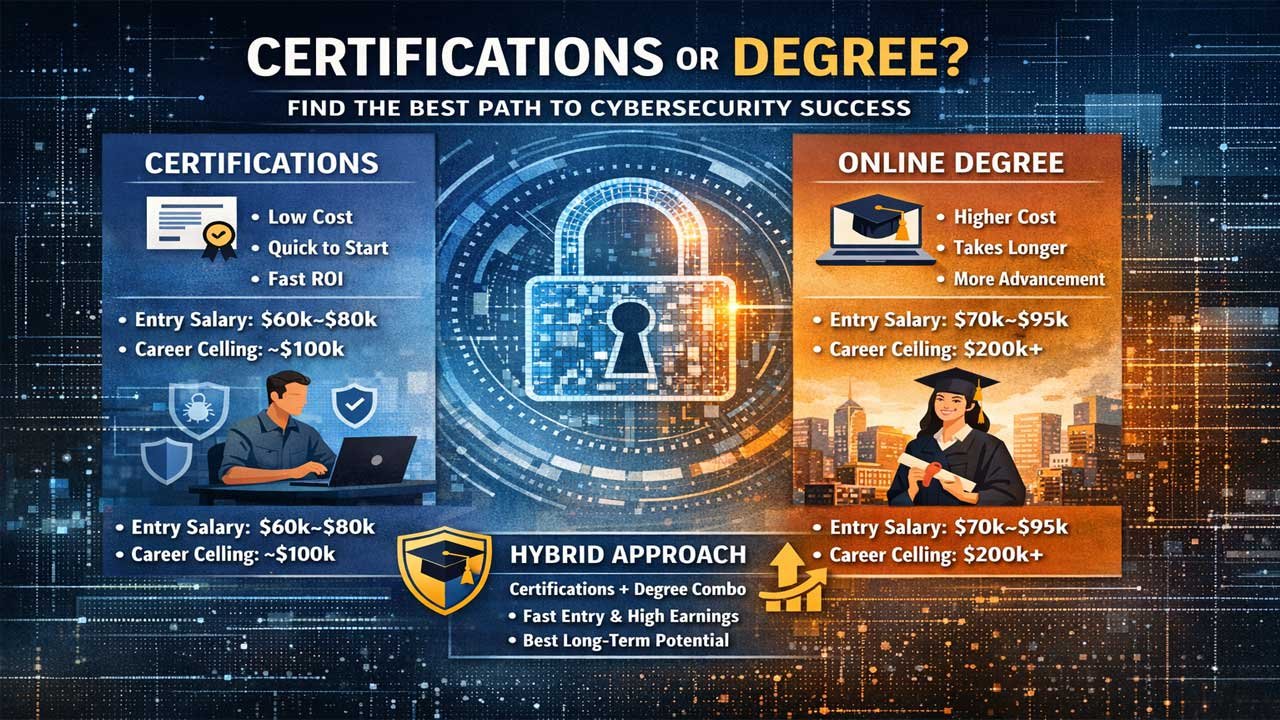
The cybersecurity profession has become one of the fastest-growing and most lucrative careers in technology, with the field projected to grow 32% through 2032—nearly four times the national average. However, aspiring cybersecurity professionals face a critical decision: pursue a formal online degree or opt for industry certifications? Both pathways lead to employment, but they differ significantly in investment, time commitment, earning potential, and career trajectory.
The verdict: Neither path is universally superior. Certifications deliver faster ROI and quicker entry into the job market (14-18 months payback), while degrees offer superior long-term earning potential and access to senior leadership roles. The optimal strategy depends on your current employment status, financial position, career timeline, and long-term ambitions. This comprehensive analysis examines the financial, professional, and practical dimensions to help you make an informed decision based on your unique circumstances.
Cost Comparison: Investment Required
Online Cybersecurity Degrees
The financial commitment for an online cybersecurity degree varies significantly by institution and delivery model, but specific investment data reveals substantial differences globally.
| Program Type | Average Cost | Duration | Entry-Level Salary |
|---|---|---|---|
| Associate’s Degree (2-year) | $13,100 | 2 years | $55,000–$70,000 |
| Bachelor’s Degree | $67,337–$74,900 | 4 years | $75,000–$95,000 |
| Online Bachelor’s (SNHU) | $20,520–$35,520 | ~3 years | $120,000+ |
| Online Bachelor’s (most affordable) | $18,480–$52,920 | 4 years | Varies |
The wide range reflects regional differences: public in-state tuition costs substantially less than private universities and out-of-state rates. However, many accredited online programs offer significantly lower costs than traditional campuses. Southern New Hampshire University’s online cybersecurity bachelor’s, for example, costs $342 per credit, totaling $20,520-$35,520 depending on transfer credit acceptance.
Total investment for online degree: $18,000–$180,000 USD depending on institution and location
Professional Certifications
Individual certifications represent a dramatically smaller upfront investment, though comprehensive credential stacking increases total costs.
| Certification | Exam Cost | Training Cost | Total Investment | Validity Period |
|---|---|---|---|---|
| CompTIA Security+ | $392 | $2,000–$3,000 | $2,400–$3,400 | 3 years |
| CompTIA CySA+ | $392 | $2,000–$3,500 | $2,400–$3,900 | 3 years |
| CEH (Certified Ethical Hacker) | $1,199 | $850–$3,499 | $2,000–$4,700 | 3 years |
| CISSP | $749 | $2,500–$4,000 | $3,250–$4,750 | 3 years |
| CISM | $575–$760 | Training varies | $2,000–$4,000 | 3 years |
| AWS Certified Security-Specialty | Exam fees vary | $2,000–$3,500 | $2,500–$4,500 | 3 years |
Total investment for entry-level certification: $2,400–$4,700
Total investment for multiple certifications (recommended path): $8,000–$15,000
Key financial insight: A single entry-level certification costs 3–15 times less than a bachelor’s degree, but comprehensive certification stacking (Security+ → CISSP or CEH → Specialized certifications) can approach degree-level investments.
Time to Employment: Speed Matters
Certification Pathway: Fastest Entry
Certifications represent the accelerated path to cybersecurity employment:
- Program duration: 2–6 months for entry-level; 6–12 months for advanced credentials
- Job placement rate: 90–96% employed within 6 months
- Average job search: 3–4 months post-certification
- Total time to employment: 6–12 months from start to first job
Working professionals can pursue certifications while maintaining current employment. Part-time study options allow evening and weekend scheduling, making this pathway particularly viable for career changers with existing IT experience.
Degree Pathway: Extended Timeline
Bachelor’s degree programs demand sustained commitment over multiple years:
- Program duration: 4 years (120 credits typical)
- Job placement rate: 93–94% within 6 months of graduation
- Average job search: 2–4 months pre-graduation
- Total time to employment: 4–4.5 years from start
However, this extended timeline offers distinct advantages: students complete multiple internships (typically 2–3 summer opportunities), accumulate substantial hands-on project experience, and develop broader foundational knowledge spanning systems architecture, networking, cryptography, and security governance.
Timeline advantage: Certifications win decisively for speed to employment—reducing the time-to-first-job by 3+ years.
ROI Analysis: Financial Returns Over Time
Return on investment represents perhaps the most quantifiable comparison between these educational pathways. The ROI calculation considers total financial investment, earning progression, and opportunity costs.
Certification ROI: Rapid Payback, Plateauing Returns
A typical entry-level cybersecurity certification delivers exceptional short-term ROI:
| Year | Annual Salary | Cumulative Earnings | Investment Recovery |
|---|---|---|---|
| Year 1 | $65,000–$75,000 | $65,000–$75,000 | 95–100% recovered |
| Year 2 | $75,000–$85,000 | $140,000–$160,000 | 100% recovered + $65K–$95K profit |
| Year 3–5 | $80,000–$95,000 | $360,000–$450,000 | Steady 8–10% annual growth |
Certification ROI calculation: With a $3,500 average investment and $65,000 starting salary, ROI = ($65,000/$3,500) × 100 = 1,857% in year one alone.
Critical limitation: Career ceiling emerges around years 5–7. Certification-only professionals typically plateau at $90,000–$110,000 annual earnings without pursuing a formal degree or transitioning to specialized technical roles requiring deeper credentials.
Degree ROI: Longer Payback, Superior Long-Term Returns
Bachelor’s degree investments show negative year-one ROI but substantially outperform certifications over multi-year horizons:
| Year | Annual Salary | Cumulative Earnings | Net Against Investment |
|---|---|---|---|
| Year 1 | $75,000–$95,000 | $75,000–$95,000 | -$0–$25,000 (recovery beginning) |
| Year 2–3 | $85,000–$105,000 | $185,000–$265,000 | Full investment recovered |
| Year 5 | $95,000–$130,000 | $450,000–$650,000 | $375,000–$575,000 profit |
| Year 10 | $120,000–$170,000+ | $1,050,000–$1,500,000 | $975,000–$1,425,000 profit |
Degree ROI calculation: With a $67,337 average investment, entry salary of $75,000, and conservative 3% annual growth, the payback period averages 3.2 years. Over a 30-year career, lifetime ROI exceeds 400%.
The most compelling difference emerges in the trajectory: degree holders’ salaries accelerate faster through the mid-career phase (years 5–12), while certification-only professionals experience salary growth deceleration without additional credentials.
Critical ROI Inflection Point: Years 5–7
The crossover moment where degree-holders’ earnings permanently exceed certification-only professionals occurs around year 5–7 of employment:
Certification path earnings (Year 7): $85,000–$100,000 with limited upward mobility
Degree path earnings (Year 7): $115,000–$140,000 with continuing advancement trajectory
This divergence widens substantially at year 10 and beyond, making degrees the superior investment for professionals planning 20+ year careers.
Salary Comparison Across Career Stages
Entry-Level Positions (0–3 Years)
At job market entry, certifications and degrees show surprising parity—sometimes favoring certifications:
Certification-based roles (Security+, CEH, GCIH):
- Average starting salary: $60,000–$80,000 USD
- India entry-level: ₹4–8 LPA (approximately $4,800–$9,600 annually)
Degree-based roles (Bachelor’s in Cybersecurity):
- Average starting salary: $70,000–$95,000 USD
- India entry-level: ₹3–6 LPA (approximately $3,600–$7,200 annually)
Insight: Entry-level candidates with advanced certifications (CISSP, CEH) often earn more than fresh degree graduates due to certification-specific salary premiums. However, degree holders rapidly close this gap as they progress.
Mid-Career Positions (5–9 Years)
Significant salary divergence emerges during mid-career progression:
| Role/Credential | Typical Salary Range | Experience Required |
|---|---|---|
| Cybersecurity Analyst (cert-based) | $88,941–$109,885 | 4–7 years |
| Cybersecurity Engineer (degree-based) | $116,347–$126,688 | 5–9 years |
| CISSP-holder | $120,000–$155,000 | 5+ years industry experience |
| Penetration Tester | $88,527–$118,484 | 4–9 years |
| Security Architect | $120,000–$143,000 | 7–10 years |
Regional variation matters significantly: New York City cybersecurity engineer salaries reach $130,248, compared to national average of $116,347. San Francisco and Washington D.C. command 15–25% premium salaries.
Senior Leadership Roles (10+ Years)
Senior positions show pronounced degree requirement and salary premium:
| Executive Role | Typical Salary | Typical Requirements |
|---|---|---|
| Information Security Manager | $120,000–$165,000 | Bachelor’s degree + 8+ years |
| Security Director | $125,000–$180,000 | Bachelor’s or Master’s + 10+ years |
| CISO (Chief Information Security Officer) | $180,000–$275,000+ | Bachelor’s + advanced certs + 12+ years |
| Security Architect | $130,000–$190,000 | Bachelor’s degree + 7+ years |
| Cybersecurity Consultant | $110,000–$160,000 | Bachelor’s recommended |
Career ceiling analysis: Certification-only professionals typically cannot access CISO, Director, or most management positions, regardless of experience. Many Fortune 500 organizations explicitly require bachelor’s degrees for roles above Senior Analyst level. This structural career limitation represents the most significant long-term ROI disadvantage for certification-only pathways.
Job Market Demand and Hiring Preferences
Understanding how employers actually evaluate candidates provides crucial ROI context.
What Do Hiring Managers Prioritize?
A 2025 survey of 929 hiring managers across six countries revealed critical insights:
Hiring manager preferences (entry/junior-level roles):
- 90% would hire candidates with IT experience alone
- 89% would hire candidates with entry-level certifications alone
- When prioritizing “critical” qualifications: Certifications (47%) > IT experience (44%) > Education (43%)
Counterintuitive finding: Hiring managers rank certifications as slightly more important than formal education for entry-level positions, contradicting the perception that employers overwhelmingly prefer degrees.
Degree Requirements: The Fine Print
Despite flexibility at entry-level, advancement requires formal credentials:
- 60% of entry-level cybersecurity positions require a college degree
- 90%+ of US cybersecurity jobs require a four-year degree
- 24% of entry-level positions prefer graduate degrees
- Many mid- to senior-level roles explicitly require bachelor’s degrees as non-negotiable requirements
Critical insight for strategic planning: Certifications enable entry-level employment, but degrees become prerequisite for advancement beyond $110,000 salary levels in most organizations.
Online Degree Recognition and Accreditation
A legitimate concern for online degree candidates involves employer recognition. Current evidence strongly supports online degree viability:
Accreditation standards ensuring employer recognition:
- NSA/DHS Center of Academic Excellence in Cyber Defense (CAE-CD) designation
- Distance Education Accrediting Commission (DEAC) recognition
- Regional accreditation from SACSCOC, WASC, or equivalent bodies
Employer perspective: Employers prioritize skills, experience, and certifications over delivery method (online vs. campus). Accredited online degrees from recognized institutions (SNHU, Arizona State University, Penn State World Campus, Brigham Young University) receive equal consideration to traditional programs.
Specialization and High-Earning Certifications
Strategic certification selection dramatically impacts earning potential and career trajectory.
Highest-Paying Specialization Certifications
Certain credentials command exceptional salary premiums:
| Certification | Average Salary | Salary Range | Career Focus |
|---|---|---|---|
| AWS Certified Security-Specialty | ~$203,600 | $180,000–$230,000+ | Cloud security |
| Certified Cloud Security Professional (CCSP) | $160,000–$170,000 | $155,000–$180,000 | Cloud governance |
| CISSP (Certified Information Systems Security Professional) | $120,000–$155,000 | $100,000–$180,000 | Leadership/strategy |
| CISM (Certified Information Security Manager) | $110,000–$140,000+ | $100,000–$170,000 | Management track |
| OSCP (Offensive Security Certified Professional) | Premium positions | Technical specialization track | Red team/penetration |
Strategic insight: Cloud-focused certifications (AWS, CCSP, CSCP) and management credentials (CISSP, CISM) command 30–50% salary premiums over traditional compliance or operations certifications. Professionals targeting six-figure earning potential should prioritize these specializations.
Long-Term Career Ceiling: The Critical Differentiator
Perhaps the most significant ROI difference between degrees and certifications emerges in long-term career ceiling—the maximum salary and role accessibility a credential enables.
Certification-Only Career Ceiling
Maximum typical earnings: $90,000–$110,000 USD
Common final roles:
- Senior Security Analyst ($100,000–$115,000)
- Security Operations Manager ($110,000–$140,000)
- Senior Penetration Tester ($120,000–$150,000)
Structural limitation: Certification-only professionals cannot access Chief Information Security Officer (CISO), Information Security Director, or most senior strategic roles, regardless of experience. A 10-year cybersecurity professional with CISSP certification hits a salary ceiling around $130,000–$155,000 when lacking a bachelor’s degree for many organizations.
Degree-Based Career Ceiling
Maximum typical earnings: $180,000–$400,000+ USD
Executive-level roles accessible:
- Chief Information Security Officer (CISO): $180,000–$275,000+
- Security Vice President: $200,000–$350,000+
- Chief Technology Officer (Security focus): $250,000–$500,000+
- Management at enterprise/Fortune 500 levels: $250,000–$600,000+
Degree holders with advanced certifications (CISSP, CISM, CCISO) access C-suite compensation packages exceeding $400,000 annually including equity and bonuses. This 3–5x earning differential over 20-year careers represents $1–2 million in additional lifetime earnings.
International Considerations: India Market Analysis
Given India’s growing cybersecurity sector, India-specific ROI analysis deserves detailed examination.
India Salary Progression Comparison
| Experience Level | Certified Professional | Degree Holder | Premium |
|---|---|---|---|
| Fresher (0–1 year) | ₹4–8 LPA ($480–$960/mo) | ₹3–6 LPA ($360–$720/mo) | Certifications slightly higher |
| Entry (1–3 years) | ₹6–10 LPA | ₹6–10 LPA | Parity |
| Mid-career (4–8 years) | ₹8–13 LPA | ₹12–18 LPA | 40–50% degree premium |
| Senior (10+ years) | ₹15–25 LPA | ₹25–40+ LPA | 60–70% degree premium |
| Executive (CISO) | Limited access | ₹40–90+ LPA | Significant degree advantage |
India-specific insight: The Indian cybersecurity market shows faster salary progression than US markets but follows similar degree vs. certification divergence patterns. By mid-career (years 5–8), degree holders earn measurably more, with the premium widening substantially in senior roles.
Indian Employer Hiring Preferences
India’s cybersecurity hiring market demonstrates unique characteristics:
- Certification acceptance strong: Indian IT consulting firms (TCS, Infosys, Wipro) heavily emphasize certifications for recruitment and rapid advancement.
- Degree preference emerging: MNCs and security-focused companies increasingly require degrees for leadership tracks.
- Experience-driven compensation: Indian firms heavily weight years of experience; a certified professional with 5 years of hands-on experience often earns comparably to a degree holder with similar tenure.
Indian market ROI advantage for certifications: The Indian market shows relatively stronger certification valuation than Western markets, particularly in the 3–5 year career phase, making certifications a viable fast-track strategy for Indian professionals.
The Hybrid Strategy: Optimal Path for Maximum ROI
Financial analysis suggests that neither pure degree nor pure certification path maximizes ROI. Instead, a hybrid approach delivers superior outcomes:
Hybrid Path for Employed Professionals (Recommended)
Timeline: 2–3 years
- Months 1–4: Pursue CompTIA Security+ certification ($2,400–$3,400 investment)
- Accelerate entry-level hiring or first promotion
- Validate baseline cybersecurity knowledge
- Months 5–18: Begin online bachelor’s degree (part-time, while employed)
- Maintain current salary while studying
- Many employers offer tuition reimbursement programs
- Years 2–3: Complete bachelor’s degree while preparing for advanced certifications
- Many degree programs incorporate CISSP, CCSP, or other advanced cert prep
- Graduating with both degree AND relevant certifications maximizes positioning
ROI outcome: Bachelor’s degree + Security+ + preparation for CISSP = $75,000 entry salary (year 0) → $95,000–$105,000 (year 3) → $130,000–$155,000 (year 7+) with pathway to executive roles
Total investment: $25,000–$40,000 (degree + cert + training)
Net benefit vs. degree-only path: Same long-term ceiling, achieved 1–2 years faster while reducing opportunity cost
Hybrid Path for Career Changers (No IT Background)
Timeline: 2–2.5 years
- Months 1–3: Pursue CompTIA A+ certification (IT fundamentals)
- Bridge IT knowledge gap
- Strengthen degree application prospects
- Months 4–8: Begin online associate’s or bachelor’s degree
- Accumulate formal credentials and comprehensive knowledge
- Months 9–12: Pursue Security+ or CCNA alongside degree coursework
- Build portfolio projects during degree program
- Year 2+: Complete bachelor’s degree and pursue specialized certifications
ROI outcome: Structured pathway from non-IT background to $70,000–$85,000 entry position (year 2) with clear trajectory to $120,000+ (year 6+)
Critical Decision Framework: Which Path Fits Your Situation?
Choose Certifications If:
- ✓ You’re employed in IT/systems administration and can study part-time ($2,500–$8,000 investment)
- ✓ You need income within 6–12 months
- ✓ You’re targeting technical specialist roles (penetration tester, threat hunter, SOC lead) rather than management
- ✓ You’re in India or emerging markets where experience commands strong premium
- ✓ You lack bachelor’s degree but have 3+ years IT experience
- ✓ Your employer reimburses certification costs
ROI profile: 400–600% ROI in years 1–2; career ceiling ~$100,000–$130,000 without additional degree
Choose Online Degrees If:
- ✓ You’re targeting leadership, management, or executive roles (CISO, Manager, Director)
- ✓ You’re willing to invest 3–4 years for substantially higher long-term earnings
- ✓ You can access tuition reimbursement or financial aid programs
- ✓ You lack IT background and need comprehensive foundational knowledge
- ✓ You want maximum career flexibility across organizations and industries
- ✓ You plan a 20+ year cybersecurity career
- ✓ You’re pursuing advanced roles in secure SDLC, cloud architecture, or governance
ROI profile: Negative year 1; 300–600% ROI by year 5; career ceiling $200,000–$400,000+
Choose Hybrid Strategy If (Optimal for Most Professionals):
- ✓ You’re currently employed in IT and can access employer tuition assistance
- ✓ You want fastest possible advancement without sacrificing long-term earning potential
- ✓ You need recognized credentials within 12 months while working toward degree
- ✓ You want to “have it all”: rapid ROI, corporate ladder advancement, and executive pathway
- ✓ You’re in a field or industry (finance, healthcare, government) requiring both credentials and degrees
ROI profile: 150–300% in year 2; 600%+ by year 5; full career ceiling access ($200,000+)
Employer Perspectives and Hiring Trends 2025–2026
Recent hiring manager surveys reveal evolving employer attitudes:
Certification Recognition Rising
ISC2 2025 Hiring Trends:
- Certifications mentioned in 47% of “critical” qualification discussions
- 89% of hiring managers would interview candidates with entry-level certifications
- Certified in Cybersecurity (CC) reaching mainstream acceptance in only its third year
Implication: Certification-based hiring expanding, particularly for entry-level and specialized technical roles. The stigma around certifications (viewed as insufficient without degrees) is diminishing.
Skills and Experience Trump Education Credentials
Key finding: The ability to demonstrate hands-on competency increasingly matters more than degree type or prestigious institution.
- 66% of security professionals value certifications over bachelor’s degrees in related fields
- 60% of companies prioritize four-year graduates for entry-level but accept certified professionals
- Portfolio projects, hands-on experience, and certifications increasingly differentiate candidates
Practical impact: A certified professional with 3 hands-on security projects in their portfolio competes effectively against degree candidates at entry-level, particularly for technical roles.
Risk Factors and Limitations
Both pathways carry distinct risks affecting ROI calculations:
Certification Risks
- Career ceiling reached: Advancement beyond $110,000 requires supplementary credentials or degree pursuit
- Credential refresh burden: Most certifications require recertification every 3 years ($50–$200 renewal fees annually)
- Specialization trap: Wrong certification choice (e.g., network-focused CCNA instead of security-focused CISSP) can impede hiring
- Experience requirement gaps: Advanced certifications (CISSP, CISM) require 5+ years paid experience, creating catch-22 if not in field
- Market saturation: Entry-level Security+ holders increasingly common, potentially weakening differentiation over time
Degree Risks
- Opportunity cost: 4 years of education vs. 4 years of earning (opportunity cost: $260,000–$380,000 in foregone salary)
- Graduate debt: Average student loan debt for cybersecurity graduates: $25,000–$40,000, reducing net ROI
- Market evolution risk: Cybersecurity technical requirements change rapidly; degree curriculums sometimes lag industry (though online programs adapt faster than traditional)
- Slower market entry: 4-year timeline delays career start and earning phase
- No guarantee of executive roles: Bachelor’s degree necessary but insufficient for CISO; requires 12+ years experience + advanced certifications + demonstrated leadership
ROI Summary Table: Side-by-Side Comparison
| Metric | Certification Path | Degree Path | Hybrid Path |
|---|---|---|---|
| Total Investment | $3,500–$8,000 | $67,000–$74,000 | $30,000–$45,000 |
| Time to Job | 6–12 months | 4–4.5 years | 18–24 months |
| Year 1 ROI | 1,400%+ | -20% to +30% | +200% |
| Year 3 ROI | 400%–600% | 100%–150% | 400%–500% |
| Year 5 ROI | 600%–800% | 250%–400% | 500%–700% |
| 5-Year Total Earnings | $400,000–$480,000 | $450,000–$550,000 | $430,000–$540,000 |
| Career Ceiling | $100,000–$130,000 | $200,000–$400,000+ | $200,000–$400,000+ |
| Executive Access | Limited | Full access | Full access |
| Long-Term (30-year) ROI | 300%–500% | 400%–600% | 450%–650% |
Conclusion: Making Your ROI-Optimized Decision
For pure financial ROI in years 1–3: Certifications win decisively. A $3,500–$8,000 investment that pays back completely within 12–18 months delivers exceptional immediate returns incomparable to any degree program.
For long-term wealth accumulation (10+ years): Degrees win comprehensively. The $200,000–$1 million additional lifetime earnings for degree holders vastly outweigh initial investment differences, particularly when accessing executive roles (CISO, VP, Director).
For optimal career trajectory and flexibility: Hybrid strategy wins. Combining rapid entry (via certification) with degree completion while employed delivers superior positioning, reduced opportunity cost, and full access to career advancement.
Market reality: The cybersecurity talent shortage continues intensifying—with fewer than 400,000 professionals to fill 1+ million job openings. Regardless of your credential choice, demand significantly favors both certified and degreed professionals. However, strategic credential selection, employer alignment, and continuous specialization matter increasingly.
The highest ROI path ultimately depends on your specific circumstances: current employment status, financial capacity, risk tolerance, and career timeline. However, the data strongly suggests that combining certifications’ speed with degree credentials’ long-term earning power creates optimal returns for professionals planning multi-decade cybersecurity careers.
Action Plan: Begin your journey this month—whether through a Security+ exam registration, online degree enrollment, or hybrid combination. The fastest path to higher cybersecurity income starts with your first credential today.
FAQs
Is cybersecurity a good career choice in 2026 and beyond?
Yes. Cybersecurity is one of the fastest-growing tech fields with strong job demand, high salaries, and long-term career stability worldwide.
Are cybersecurity certifications enough to get a job?
Yes. Entry-level certifications like Security+ can secure junior roles, especially for candidates with IT experience.
Do I need a degree to work in cybersecurity?
No. Many entry-level roles accept certifications and experience, but degrees become important for senior and leadership roles.
Which pays more in the long term: degree or certifications?
Degrees typically lead to higher lifetime earnings and access to executive roles, while certifications pay faster initially but plateau earlier.
What is the fastest way to enter cybersecurity?
Certifications are the fastest path, often leading to employment within 6–12 months.
Is an online cybersecurity degree respected by employers?
Yes. Accredited online degrees are treated the same as on-campus degrees by most employers.
What is the typical starting salary in cybersecurity?
Entry salaries range from $60,000 to $95,000 depending on credentials, region, and role.
Can I become a CISO with certifications only?
Rarely. Most CISO and director roles require at least a bachelor’s degree plus advanced certifications and experience.
Which certifications give the highest salaries?
Cloud and leadership certifications such as AWS Security Specialty, CCSP, CISSP, and CISM command the highest pay.
Is a hybrid path better than choosing only one option?
Yes. Combining certifications with a degree offers fast entry, strong ROI, and full career ceiling access.
How long does it take to recover certification costs?
Usually within 12–18 months, often in the first year of employment.
How long does it take to recover degree costs?
Typically 2–4 years after graduation, depending on tuition and starting salary.
Do employers prefer certifications or degrees for entry roles?
Employers slightly favor certifications and hands-on skills for entry-level roles.
Are cybersecurity jobs future-proof?
Largely yes. Cyber threats continue to grow, sustaining long-term demand.
Can career changers enter cybersecurity without IT background?
Yes, but starting with basic IT certifications or foundational courses is strongly recommended.
Is cybersecurity oversaturated?
No. There is still a large global talent shortage across all experience levels.
What is the salary ceiling without a degree?
Most professionals plateau around $100,000–$130,000 without a degree.
What is the maximum earning potential with a degree?
Senior leaders can earn $200,000–$400,000+ annually including bonuses and equity.
Is experience more important than education?
Experience and skills matter most, but degrees become gatekeepers for senior roles.
Are certifications valid forever?
No. Most require renewal every three years with continuing education or fees.
Is cybersecurity better than software engineering financially?
Both pay well, but cybersecurity offers stronger job security and leadership salary upside.
Which path is best for working professionals?
Hybrid paths allow working while studying and deliver the best ROI.
Can certifications replace internships?
No. Certifications validate knowledge, but internships and projects build practical experience.
Is cybersecurity suitable for non-technical people?
Yes. Governance, risk, compliance, and management tracks require less coding and more policy and strategy skills.
Do Indian professionals benefit more from certifications?
Yes. In early career stages, certifications often deliver faster salary growth in India.
Do multinational companies require degrees?
Most mid-to-senior roles in MNCs require bachelor’s degrees.
What is the best first certification?
CompTIA Security+ is the most widely accepted entry-level certification.
Is CISSP useful without experience?
No. CISSP requires five years of professional experience to be fully certified.
Are cybersecurity degrees outdated quickly?
Some curriculums lag, but accredited online programs update content regularly.
Can I study cybersecurity part-time?
Yes. Both certifications and online degrees support part-time study.
Which path has lower financial risk?
Certifications carry lower upfront cost and lower financial risk.
Which path offers better job mobility across countries?
Degrees combined with global certifications provide the strongest international mobility.
Is portfolio work important in cybersecurity hiring?
Yes. Labs, projects, and real-world simulations significantly improve employability.
Can I switch from IT support to cybersecurity with certifications?
Yes. This is one of the most common and successful transition paths.
Do cybersecurity managers need technical backgrounds?
Yes. Most leadership roles require prior technical experience.
Is cloud security the highest-paying specialization?
Currently yes. Cloud and security architecture roles command the highest premiums.
Is government cybersecurity hiring degree-focused?
Yes. Government and defense sectors strongly prefer formal degrees.
Does company size affect credential requirements?
Yes. Large enterprises require degrees more often than startups or consultancies.
Is cybersecurity stressful as a career?
It can be, especially in incident response and SOC roles, but governance and consulting tracks are more balanced.
Are online labs and bootcamps effective?
They are effective supplements but not replacements for recognized credentials.
Which path gives the best flexibility to change roles later?
Degrees provide broader flexibility across technical, management, and executive tracks.
Is cybersecurity suitable for long-term career growth?
Yes. It offers one of the strongest long-term advancement and salary trajectories in technology.
What is the single best strategy overall?
Start with certifications for fast entry, then complete a degree while working for maximum ROI and career ceiling.


Leave a Reply
You must be logged in to post a comment.