
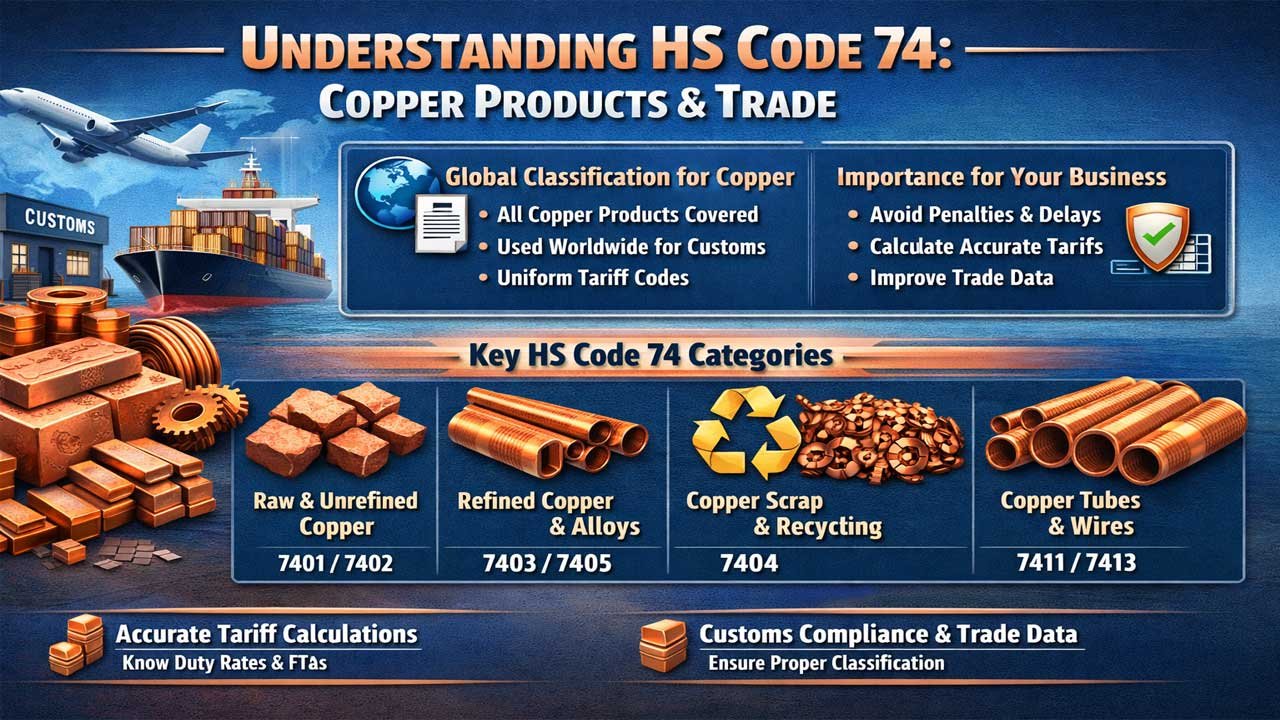
HS Code 74 classifies copper and articles thereof. This code covers all copper products. It includes raw copper, refined copper, and finished articles. Chapter 74 falls under Section XV. This section covers base metals and articles.
The Harmonized System Code ensures uniform product classification. It applies worldwide for customs purposes. Every country uses HS codes for tariff classification. Proper classification protects your finances. It also unlocks supply chain advantages.
Why HS Code 74 Matters for Your Business
Import and Export Compliance
Using the correct HS code is mandatory for all shipments. Incorrect classification leads to penalties. It can result in shipment delays at customs. You may face substantial fines and legal issues. Proper HS code usage ensures smooth clearance.
Tariff Duty Calculations
Each HS code carries specific tariff rates. These rates vary by importing country. For example, US copper imports faced 50% tariffs in 2025. India considers duty-free copper scrap imports. These tariff changes affect your shipping costs directly.
Trade Data and Analytics
Correct HS codes enable accurate trade data tracking. You can monitor market trends effectively. You can identify top exporters and importers. You can analyze pricing patterns and demand. This data drives better business decisions.
Complete HS Code 74 Product Classifications
Raw and Unrefined Copper Products
HS Code 7401: Copper Mattes and Cement Copper
Copper mattes are intermediate copper products. They contain partially refined copper. Cement copper means precipitated copper. This category applies to early-stage copper processing. These products move to refineries next.
HS Code 7402: Unrefined Copper and Copper Anodes
Unrefined copper contains impurities. It undergoes electrolytic refining. Copper anodes are used in refining processes. These are sent to electrolytic cells. The electrolysis purifies the copper.
Refined Copper and Alloys
HS Code 7403: Refined Copper and Copper Alloys
Refined copper contains at least 99.85% copper by weight. Some refined copper contains 97.5% copper minimum. Copper alloys mix copper with other metals. Brass is copper mixed with zinc. Bronze is copper mixed with tin. These alloys have specific uses in manufacturing.
HS Code 7405: Master Alloys of Copper
Master alloys contain more than 10% copper by weight. They are not malleable. They serve as additives in metallurgy. They act as deoxidants in processes. They improve properties of other alloys.
Copper Waste and Recycled Materials
HS Code 7404: Copper Waste and Scrap
Copper waste includes discarded copper items. Scrap copper comes from manufacturing processes. Recycled copper generates lower customs duties. India aims to make copper scrap imports duty-free. This encourages recycling industries.
HS Code 7406: Copper Powders and Flakes
Copper powders are finely divided copper particles. Flakes are thin copper pieces. These forms are used in specialized manufacturing. Electronics and coatings use these products. Powder metallurgy applications benefit from these items.
Copper Semi-Finished Products
HS Code 7407: Copper Bars, Rods and Profiles
Bars are solid copper pieces. Rods are cylindrical copper products. Profiles have specific cross-sectional shapes. These are semi-finished materials. Manufacturers process them into final goods. Construction and electrical industries use these.
HS Code 7408: Copper Wire
Copper wire conducts electricity efficiently. Refined copper wire has high purity. Flat copper wire serves solar industry applications. Tinned copper interconnect wire is for photovoltaic ribbons. Solar panel manufacturing uses specialized copper wire.
HS Code 7409: Copper Plates, Sheets and Strip
Thickness exceeding 0.15 mm falls here. Rolled copper products come in sheets. Plates are thicker copper pieces. Strip is continuous rolled copper. These are used in various manufacturing sectors.
HS Code 7410: Copper Foil
Foil thickness does not exceed 0.15 mm. It may be printed or backed. Backing can be paper, paperboard, or plastic. Electronics manufacturing uses copper foil extensively. PCB (Printed Circuit Board) production depends on foil.
Copper Tubes, Pipes and Fittings
HS Code 7411: Copper Tubes and Pipes
Tubes are hollow cylindrical products. Pipes serve fluid transport. HVAC systems use copper tubes. Plumbing applications require copper pipes. Heat exchangers utilize these products widely.
HS Code 7412: Copper Tube and Pipe Fittings
Fittings connect pipes and tubes together. Couplings join two pipe sections. Elbows change pipe direction. Sleeves protect pipe connections. These components are essential in installations.
HS Code 7413: Stranded Wires and Cables
Stranded wires twist multiple copper strands together. Cables contain insulation around wires. Electrical power transmission uses cables. Building wiring requires these products. Telecommunications use specialized copper cables.
Copper Fasteners and Hardware
HS Code 7415: Copper Fasteners and Hardware
Nails are sharp fastening devices. Tacks are small nails. Drawing pins attach papers. Staples join materials together. Screws have threaded shafts. Bolts and nuts assemble components. Washers distribute load. Rivets permanently join materials. Copper fasteners resist corrosion effectively. Marine and outdoor applications prefer copper fasteners.
Copper Household Articles and Sanitary Ware
HS Code 7418: Copper Household Articles and Sanitary Ware
Table articles include utensils and cutlery. Kitchen articles comprise pots and pans. Household items are everyday copper products. Pot scourers clean cookware. Scouring pads remove dirt. Polishing pads restore shine. Gloves protect during cleaning. Sanitary ware includes bathroom fixtures. Copper’s antimicrobial properties are valuable here.
HS Code 7419: Other Articles of Copper
This is the catch-all category. Chains and chain parts fall here. Specialty copper products are classified. Art objects made from copper. Decorative items using copper. Any copper article not fitting elsewhere belongs in 7419.
Current Trade Regulations and Tariffs
US Tariff Changes (2025)
Effective August 1, 2025, new tariffs apply. Semi-finished copper faces 50% duty. Copper derivatives face the same tariff. HTSUS subheadings 9903.78.01 and 9903.78.02 apply. The tariff separates copper from non-copper content.
Implications for Importers:
- Report copper content separately from other materials
- Keep detailed documentation for copper content
- Full tariff applies if content cannot be verified
- Duties are not eligible for drawback
- Filing requirements increased substantially
India’s Import Duty Trends (2025)
Copper scrap import duty was 2.5% in 2024. Budget 2025 considers making it duty-free. This encourages domestic recycling industries. Domestic copper smelters face import pressure. Over 1,000 importers faced customs investigations. These investigations targeted ASEAN FTA misuse.
FTA-Related Issues:
- Zero-duty imports from UAE, ASEAN countries
- Indonesia processes copper through ASEAN partners
- Tariff Rate Quota (TRQ) became inflated
- 340% surge in UAE copper imports to India
- Domestic industry faces severe economic stress
How to Use HS Code 74 for Your Imports and Exports
Step 1: Identify Your Product
Determine the exact form of your copper product. Is it raw copper or finished? Does it contain alloys? What is the shape and dimension? Accurate identification ensures correct coding.
Step 2: Find the Specific Heading
Match your product to the heading descriptions. Each heading has exact criteria. A product must fit all the criteria. If it doesn’t fully match, try the next heading. Precision prevents customs delays.
Step 3: Check for Subheadings
Many headings have subheadings with more details. Subheadings provide additional classification levels. Refining your classification improves accuracy. Check all notes and conditions carefully.
Step 4: Verify Tariff Rates
Look up the tariff rate for that HS code. Rates vary by importing country. Some countries offer preferential rates under FTAs. Calculate duty costs before shipping. Budget for tariff expenses.
Step 5: Prepare Documentation
Gather bills of materials. Collect supplier invoices. Document copper content percentages. Prepare certificates of origin. Submit accurate entry summaries to customs. Keep records for at least 3-5 years.
Common Mistakes in HS Code Classification
Confusing Similar Products
Copper wire and copper cable are different. Wire is bare copper. Cable has insulation. Using wrong codes attracts penalties. Always verify product specifications carefully.
Ignoring Product Composition
A product’s alloy content matters. Brass and bronze have different codes. Copper content percentages matter. Mixing codes reduces compliance significantly.
Missing Subheading Requirements
Many codes have specific conditions. Flat copper wire for solar uses code 7408. General copper wire differs. Ignoring conditions causes clearance delays.
Incorrect Tariff Calculations
Different countries have different rates. FTA countries may have lower rates. You must verify each destination’s rates. Miscalculation affects profit margins directly.
Recent Market Trends and Opportunities
Copper Industry Challenges
Global copper smelting faces economic stress. Treatment and refining charges dropped 80%. Projections show TC/RC at zero for 2026. Smelting becomes unviable at these rates. Refiners seek government protection measures.
Growing Demand Sectors
Solar photovoltaic industry demands copper wire. Electric vehicle manufacturing needs copper. Electronics production requires copper foil. Building and construction use copper tubes. Renewable energy drives copper demand.
Copper Recycling Growth
Recycled copper reduces import dependency. India considers duty-free scrap imports. Quality recycling requires modern technology. Environmental benefits drive recycling adoption. Economic incentives support growth sectors.
FAQs on HS Code 74
Q: What is the difference between HS codes 7403 and 7405?
A: Code 7403 is refined copper and finished copper alloys. Code 7405 is master alloys with special metallurgical use. Master alloys are not malleable. They serve as additives in metallurgy. The distinction matters for compliance.
Q: Can copper waste use different HS codes?
A: Copper waste and scrap use code 7404. Processed waste sometimes classifies differently. Check the exact form and composition. Recycled copper products have specific codes. Verification prevents misclassification penalties.
Q: How do I determine copper content for duty calculation?
A: Use bills of materials as documentation. Get supplier invoices for proof. Laboratory testing confirms content percentages. Keep records for customs verification. Undeclared content attracts significant penalties.
Q: What happens with incorrect HS code classification?
A: Customs can reassess duties owed. Penalties range from 10% to 100% of duties. Legal action may result. Criminal charges apply in severe cases. Your import privileges face suspension risks.
Q: Are there exemptions for specific copper products?
A: Solar PV ribbon wire has exemptions. Specific conditions must be met. Some FTA countries have reduced rates. Green energy initiatives offer incentives. Check current regulations regularly.
Conclusion
HS Code 74 covers all copper products comprehensively. Proper classification ensures smooth customs clearance. Tariff calculations become accurate with correct codes. Recent regulatory changes affect copper importers significantly. Staying updated protects your business interests. Using professional customs consultants is worthwhile. They help navigate complex regulations effectively. Export-import success depends on classification accuracy.


