
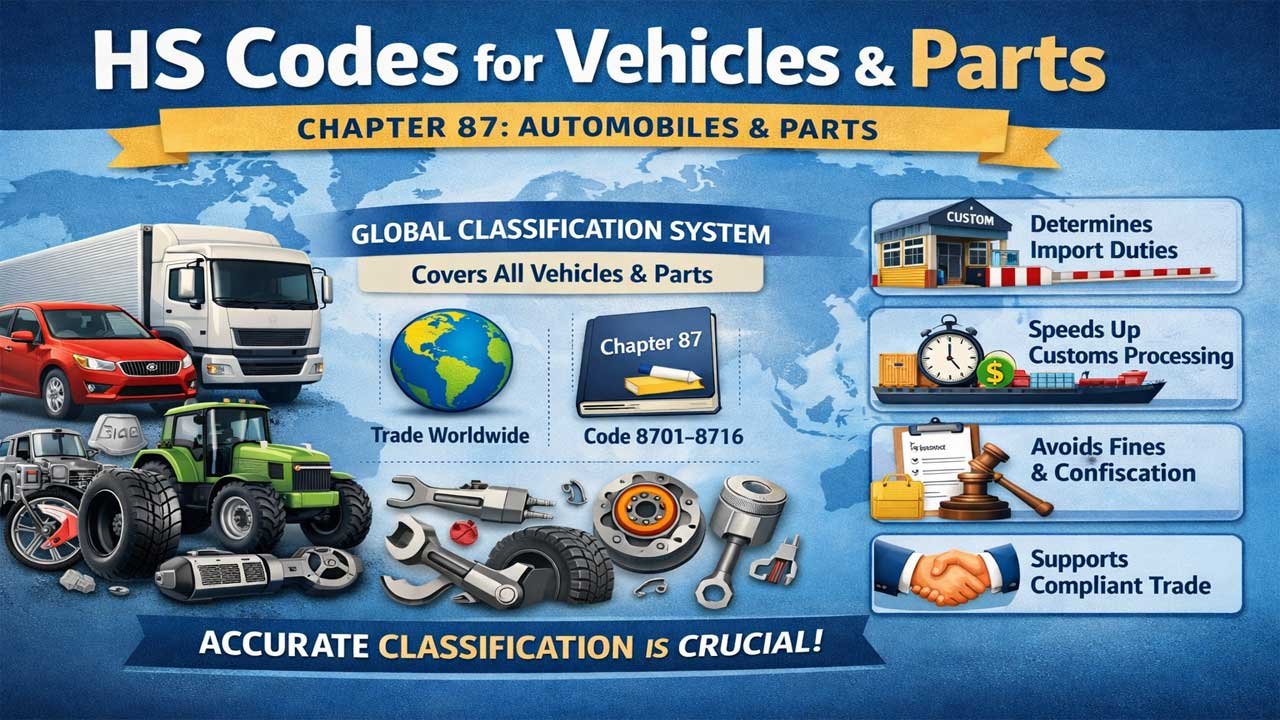
The HS code system is used worldwide. It classifies all traded goods. HS means Harmonized System. It is a standardized method. It ensures global consistency. Vehicles fall under Chapter 87. This chapter covers all vehicles. It includes cars, trucks, and buses. It includes tractors and motorcycles. It also includes bicycles. Parts and accessories are included too.
The HS code is crucial for trade. It determines import duties. It affects customs clearance. It influences shipping costs. Businesses must use the correct code. Incorrect codes cause delays. They result in additional fines. They can lead to cargo confiscation. Accurate classification saves money. It speeds up customs processing.
Chapter 87: Vehicles Other Than Railway or Tramway Rolling-Stock
Chapter 87 is the main section. It covers all non-railway vehicles. It includes vehicle parts and accessories. This chapter has 16 main headings. Each heading covers specific vehicle types. Each comes with detailed subcategories.
Understanding Chapter 87 is essential. It contains the most traded vehicle codes. The codes determine legal obligations. They affect tax calculations. They influence trade agreements. Different countries apply these codes. They follow the same international standard.
Main Vehicle HS Codes Explained
HS Code 8701: Tractors
Tractors are classified under 8701. This includes agricultural tractors. It includes industrial tractors. It does not include garden tractors. The code requires specific engine specifications. Engine size and fuel type matter. Power output determines classification.
HS Code 8702: Vehicles for Ten or More Persons
This code covers buses and large vehicles. They must carry 10 or more persons. The driver is included in the count. This includes coaches. It includes minibuses over the threshold. Public transport vehicles fall here.
HS Code 8703: Motor Cars and Passenger Vehicles
Most personal vehicles fall here. This includes sedans and SUVs. Station wagons are included. Racing cars are covered too. Engine displacement matters for classification. Fuel type affects the specific code. Cylinder capacity determines the subheading.
HS Code 8704: Motor Vehicles for Goods Transport
This code covers trucks and commercial vehicles. They are designed for cargo transport. Maximum weight specifications apply. Payload capacity varies by subcode. Compression-ignition engines are classified separately. Spark-ignition engines have different rates.
HS Code 8705: Special Purpose Vehicles
These are non-standard vehicles. They include fire trucks. Breakdown lorries are covered. Concrete mixer vehicles are included. Spraying lorries fall here. Mobile workshops are classified here. Ambulances and specialized vehicles apply.
HS Code 8706: Chassis Fitted with Engines
Chassis with engines are separate codes. They must have complete engines. Partial assemblies need different classification. This category supports vehicle assembly. Manufacturers use this extensively.
HS Code 8707: Bodies and Cabs
Vehicle bodies and cabs are classified separately. Cabs without engines fall here. Body panels are included. This code excludes windscreens. Windows are classified differently. Bumpers are separate items.
HS Code 8708: Parts and Accessories of Motor Vehicles
This is the largest category. It covers all vehicle parts. It includes hundreds of subcategories. Everything from brakes to batteries applies. This heading is crucial for businesses. Most automotive trade falls here.
HS Code 8711: Motorcycles and Mopeds
Motorcycles have their own codes. Mopeds are included here. Cycles with auxiliary motors apply. Side-cars have specific classifications. Engine displacement matters. Fuel type affects the code.
HS Code 8712: Bicycles and Non-Motorized Cycles
Non-motorized bicycles fall here. Delivery tricycles are covered. These are non-motorized vehicles. Children’s bicycles have specific codes. Wheels over 55cm diameter matter. Different wheel sizes affect classification.
HS Code 8708: Parts and Accessories Breakdown
HS code 8708 is the most important. It covers parts for vehicles 8701-8705. This includes thousands of specific items. Each part has its own detailed code.
Bumpers and Safety Components (87081010-87082900)
Bumpers protect vehicle bodies. They come with or without parts. Bumpers for tractors are separate (87081010). Safety seat belts are classified separately (87082100). Windscreens and windows have specific codes (87082200). Other safety components are grouped (87082900).
Basic duty rates for bumpers are 15%. IGST varies by specific classification. Safety components range from 18-28% IGST. Windscreens may have different rates. These are commonly traded items.
Brakes and Servo-Brakes (87083000)
Brakes are essential vehicle components. Servo-brakes with hydraulic power are included. Brake linings are separate. Anti-lock braking systems apply here. Brake drums and discs are covered. Electronic brake components fall here.
Basic duty on brakes is 15%. IGST is 18% or 28% depending on type. Brake-related imports are high-volume trade. Different vehicle types have different requirements. Correct classification prevents duty errors.
Gearboxes and Transmission Parts (87084000)
Gearboxes are transmission units. Automatic transmissions are included. Manual gearboxes are covered. Continuously variable transmissions (CVT) apply here. Transmission fluid pumps are included. Torque converters are classified here.
Basic duty is 15% on gearboxes. IGST is 18% or 28%. Transmissions are expensive components. Correct classification affects import costs significantly. Different vehicle types use different transmissions.
Drive-Axles and Differential Systems (87085000)
Drive-axles transfer power to wheels. Differentials allow different wheel speeds. Non-driving axles are separate. These are complex assemblies. Multiple parts can be involved. Assembly configuration matters.
Road Wheels and Tire Components (87087000)
Wheels and rims are classified here. Tire components are separate. Wheel bearings apply here. Hub assemblies are included. Aluminum wheels have standard rates. Steel wheels are classified the same way.
Basic duty is 15%. IGST is 18% or 28%. Wheels are frequently imported items. Different sizes have the same classification. Material differences don’t affect the HS code.
Suspension Systems and Shock Absorbers (87088000)
Suspension systems control vehicle movement. Shock absorbers dampen vibrations. Springs are included here. Stabilizer bars and bushings apply. Independent suspension components are covered. Complete suspension assemblies are included.
Basic duty is 15%. IGST is 28%. Suspension systems are complex assemblies. Different vehicle types have different systems. Imports depend on vehicle manufacturing demand.
Radiators and Cooling Systems (87089100)
Radiators cool engine coolant. Heat exchangers are included. Radiator fans may be separate. Cooling system hoses are different items. Thermostats apply here. Water pumps for cooling are classified separately.
Basic duty is 15%. IGST is 18% or 28%. Radiators are essential for engine operation. Different engine sizes require different radiators. Replacement parts are frequently imported.
Silencers, Mufflers, and Exhaust Pipes (87089200)
Mufflers reduce engine noise. Exhaust pipes carry gases away. Catalytic converters are included. Emission systems fall here. Exhaust manifolds may have different codes. Resonators are separate items.
Basic duty is 15%. IGST is 18% or 28%. Emissions regulations drive demand. Environmental standards affect this market. Replacement exhaust systems are commonly traded.
Clutches and Transmission Clutches (87089300)
Clutches engage and disengage engines. Manual transmission clutches apply here. Automatic transmission clutches are separate. Clutch pressure plates are included. Release bearings fall here. Friction materials are included.
Basic duty is 15%. IGST is 18% or 28%. Clutches are wear components. Replacement demand is steady. Different vehicle types use different clutch systems.
Steering Components (87089400)
Steering wheels control vehicle direction. Steering columns support these wheels. Steering boxes house the mechanism. Power steering systems are included. Steering pumps may be separate. Electronic steering components apply here.
Basic duty is 15%. IGST is 18% or 28%. Steering safety is critical. Different vehicle types have different steering systems. Power steering increases complexity.
Safety Airbags and Inflater Systems (87089500)
Airbags protect occupants in crashes. Inflater systems deploy bags rapidly. Air bag housings are included. Electronic control modules may differ. Multiple airbags per vehicle exist. Replacement airbags are safety-critical items.
Basic duty is 15%. IGST is 28%. Airbags are safety-regulated components. Design variations affect different vehicles. Replacement demand follows accident patterns.
Other Parts and Accessories (87089900)
This is a catch-all category. It covers parts not specifically listed. Engine parts may fall here. Electrical components are sometimes classified here. Fuel system components may apply. Various interior components fit here.
Basic duty is 15%. IGST is 18% or 28%. This category is broad and complex. Exact classification requires careful analysis. Professional guidance is often needed.
Understanding Tariff Codes and Customs Duties
Import duties vary by country. India applies basic duty of 15%. IGST (Integrated Goods and Services Tax) ranges from 18-28%. Social welfare surcharge is 10%.
The United States has different rates. The European Union applies its own tariffs. Free trade agreements reduce duties. Some countries offer zero tariffs. Others apply protective tariffs. Duty calculations affect final costs.
Incorrect classification causes serious problems. Over-taxation damages customer relationships. Under-taxation risks fines and penalties. Customs delays halt shipments. Goods can be confiscated. Proper classification prevents all these issues.
Classification Rules and Requirements
General Rule of Interpretation (GRI) Number 1 is crucial. Headings are determined by wording. The first four digits identify the main heading. Notes to chapters and sections provide definitions.
Section Note 3 is particularly important. Parts and accessories must be “identifiable as being meant solely or principally” for vehicles. Generic parts with standard shapes don’t qualify. Precision-manufactured parts do qualify. Specific drillings and grooves prove automotive use.
Exclusivity Test: Parts must show they are for vehicles. Common geometric shapes may not qualify. They might be classified as raw materials. Specialized automotive parts are clearly identifiable. Custom shapes and designs prove dedication.
Material-Based Classification: If parts are too generic, materials determine classification. Plastic sheets classify as plastic (Chapter 39). Steel sheets classify as steel (Chapter 72). This prevents over-classification. It protects other industries.
Documentation Required for Vehicle Parts Imports
Commercial Invoices are mandatory documents. They show transaction details. They include prices and quantities. They list items specifically. Accurate descriptions are essential.
Bill of Lading proves shipment. It shows origin and destination. It documents carrier information. It includes shipment dates. It proves possession and movement.
Import Declarations specify goods and values. They include tariff classifications. They show applicable duty rates. They declare country of origin. They are required for customs processing.
Certificate of Origin establishes country of manufacture. It determines preferential tariff eligibility. It proves qualifying status. It is needed for free trade agreements. Some countries require certified origin.
Compliance Certificates show safety standards met. Environmental certificates may apply. Technical certifications are required. Testing reports support claims. These prevent import rejections.
Documentation Errors cause serious delays. Missing documents halt shipments. Incorrect classifications invite penalties. Incomplete certificates require resubmission. Proper documentation is critical.
Customs Procedures and Clearance Process
Initial Document Submission starts customs review. Officials check completeness first. They verify invoice accuracy. They confirm origin documentation. They review compliance certificates.
Classification Review determines duty rates. Tariff officers analyze HS codes. They compare products to descriptions. They apply interpretation rules. They may request reclassification.
Value Assessment calculates duties owed. CIF value includes costs and freight. Insurance is included in assessment. Duties apply to total assessed value. Accurate valuation is essential.
Duty Calculation determines final amount. Basic duty is applied first. IGST is calculated on base plus duty. Social welfare surcharge adds to total. Total determines import cost.
Goods Release occurs after payment. Physical inspection may occur. Risk assessment determines inspection need. Inspection may be cursory or thorough. Release allows customs clearance.
Free Trade Agreements and Reduced Duties
India maintains free trade agreements. Japan agreement reduces vehicle duties. South Korea agreement lowers tariffs. ASEAN countries enjoy preferential rates. These can reduce duties significantly.
Qualifying Requirements are strict. Origin certificates are necessary. Qualifying percentage thresholds apply. Manufacturing locations matter. Proper documentation is required.
Benefits Are Substantial: Reduced or eliminated duties. Improved competitive positioning. Lower final product costs. Increased market access. Strategic advantage in trade.
Application Requirements include proper paperwork. Origin certificates must be valid. Qualifying percentages must be met. Import-export licenses apply. Professional verification is wise.
Vehicle Parts Compliance Standards
Bureau of Indian Standards (BIS) certification is required. Testing validates safety standards. Performance specifications are verified. Materials are tested. Compliance certificates are issued.
Safety Standards are non-negotiable. Airbags must deploy correctly. Brakes must meet stopping distances. Seats must protect occupants. Electrical systems must be safe.
Environmental Standards apply increasingly. Emissions limits are strict. Fuel consumption standards apply. Noise limits are enforced. Recycling requirements are growing.
Quality Assurance documents show manufacturing standards. Test reports validate performance. Certifications prove compliance. Documentation supports import claims. Proper records prevent rejection.
New HS Codes for Modern Vehicles
Electric Vehicle Batteries have new codes. HS code 8507.60 is specific to EV batteries. Lithium-ion technology is covered. New classification reflects market growth. Import volumes are increasing rapidly.
Autonomous Driving Systems are now classified. Radar apparatus for ADAS has code 8526.92. Advanced sensors fall here. Electronic control modules are specific. AI processors use code 8542.39.
Advanced Materials have new codes. Composite materials use code 3921.90. Carbon fiber components apply. Lightweight materials for EV bodies. Aluminum structural parts use 7616.99.
Battery Technologies are increasingly important. High-voltage systems require specific codes. Thermal management systems are separate. Power electronics are classified separately. Battery pack assembly matters.
Practical Tips for Correct Classification
Use Official Resources: Government tariff databases are authoritative. WCO nomenclature provides guidance. Country-specific resources are helpful. Professional databases are accurate. Official sources prevent errors.
Consult Technical Specifications: Manufacturers provide detailed descriptions. Technical drawings show part functions. Assembly diagrams clarify purpose. Specifications determine classification. Gather all technical information.
Seek Expert Advice: Customs brokers know regulations. Import specialists have experience. Trade consultants understand classifications. Professional verification prevents errors. Expert guidance saves money.
Maintain Complete Records: Keep all documentation organized. Store certificates safely. Document decisions made. Track correspondence with customs. Records support future imports.
Review Updates Regularly: HS codes change every five years. New classifications emerge. Regulations are updated. Market changes affect codes. Stay informed continuously.
Common Misclassification Errors
Generic Parts Classified as Vehicle Parts: Standard shapes don’t qualify. Bolts and screws may not apply. General fasteners are wrong. Specialized fasteners are correct. Material composition matters.
Engines Misclassified: Engine type determines heading. Gasoline and diesel differ. Spark-ignition vs. compression-ignition varies. Replacement engines can be complex. Specifications determine code.
Assembly Level Confusion: Complete assemblies differ from kits. Assembled bodies have codes. Unassembled components differ. Packaging affects classification. Assembly state matters.
Wrong Vehicle Category: Passenger vs. commercial vehicles differ. Gross vehicle weight rating (GVWR) matters. Seating capacity affects classification. Purpose of design is key. Vehicle function determines code.
Industry Trade Data and Market Insights
Global Trade Volume: Automotive parts trade exceeds \$791 billion annually. Vehicle components are top-traded items. Parts represent significant trade value. Global demand continues growing. Supply chains are complex.
Top Traded Categories: Drive systems are most traded. Electrical systems are significant. Mechanical parts dominate volume. Safety components are growing. Electronic parts are increasing.
Regional Patterns: China dominates vehicle parts export. India imports significant volumes. Europe manufactures specialized parts. North America has strong demand. ASEAN is growing rapidly.
Market Trends: Electric vehicle parts are surging. Battery technology drives growth. Autonomous system components expanding. Advanced materials increasing. Safety systems demanded more.
Penalties for Non-Compliance
Duty Underpayment: Results in significant fines. Interest accrues on unpaid duties. Penalties compound over time. Customs can audit past imports. Legal liability is personal.
Goods Confiscation: Incorrect classification risks seizure. Customs can hold merchandise. Release may be denied. Goods may be destroyed. Financial loss is total.
Import Denial: Wrong classification can prevent entry. Goods are returned to sender. Shipping costs are wasted. Schedules are disrupted. Customers lose trust.
Legal Consequences: Criminal liability is possible for fraud. Civil penalties are enforced. Business licenses can be suspended. Trade privileges can be revoked. Reputational damage occurs.
Delayed Clearance: Every day of delay costs money. Warehouse fees accumulate. Insurance extends. Business schedules slip. Customers suffer delays.
Finding the Right HS Code for Your Product
Step One: Identify Product Category – Determine what type it is. Is it a complete vehicle? Is it a component? Is it an assembly? Is it a finished part? Category determines heading.
Step Two: Check Chapter Notes – Review Chapter 87 notes carefully. They define terms like “parts” and “accessories.” They clarify inclusions and exclusions. They provide classification rules. Notes are legally binding.
Step Three: Review Detailed Headings – Examine 8701-8716 headings. Find the most specific match. Consider all relevant headings. Check for competing categories. The best fit is required.
Step Four: Examine Subheadings – Look at 6-digit codes. Find specific subcategories. Consider material composition. Check assembly configuration. Match all details precisely.
Step Five: Apply GRI Rules – Use General Rules of Interpretation. Consider all relevant notes. Apply them systematically. Document your reasoning. GRI ensures consistency.
Step Six: Verify with Official Sources – Confirm with government database. Check WCO nomenclature. Review binding rulings. Consult trade databases. Official confirmation prevents errors.
Step Seven: Consult Professionals if Uncertain – Customs brokers can advise. Import specialists help verify. Trade consultants provide guidance. Professional verification is worth the cost. Errors are more expensive.
Conclusion
HS codes for vehicles are complex but manageable. Chapter 87 provides comprehensive coverage. HS code 8708 dominates parts and accessories. Correct classification is legally required. It saves time and money. It prevents penalties and delays. It ensures smooth customs clearance.
Vehicle parts represent enormous trade value. Classification accuracy is critical. Documentation must be complete. Duties must be calculated correctly. Compliance standards must be met. Professional guidance is often worthwhile. Staying updated on changes is essential.
The automotive industry continues evolving. Electric vehicles require new codes. Autonomous systems are changing classification. Advanced materials create new categories. Proper classification adapts to these changes. Understanding HS codes positions businesses for success. Knowledge of these systems prevents costly mistakes. Compliance ensures efficient operations worldwide.


